Executive Summary
The survey received 57 submissions. 56 respondents consented and were included in the analysis; 1 non-consenting response was excluded.
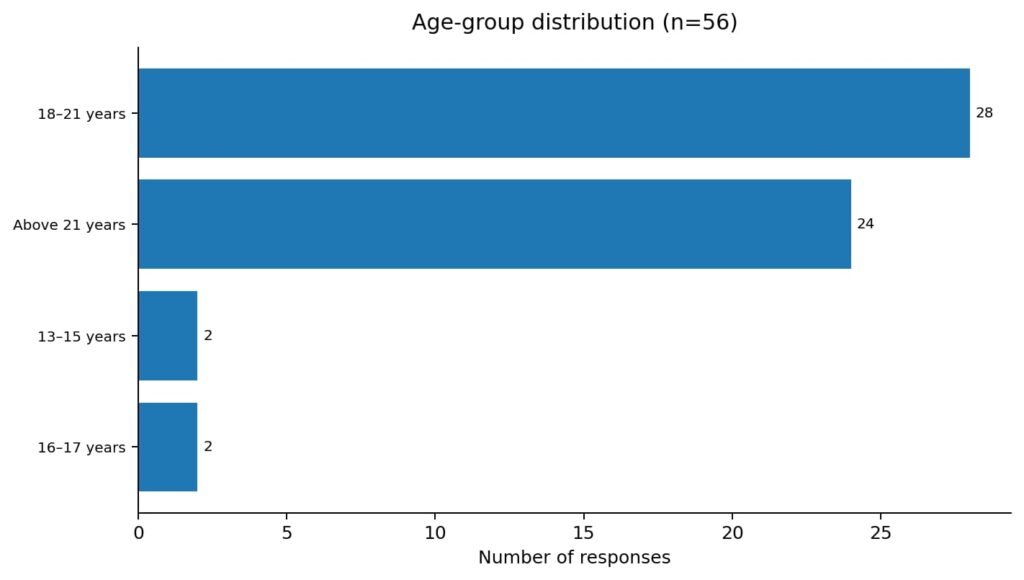
Respondents aged 18–21 years form the largest age group (28, 50.0%), followed by respondents above 21 years (24, 42.9%).
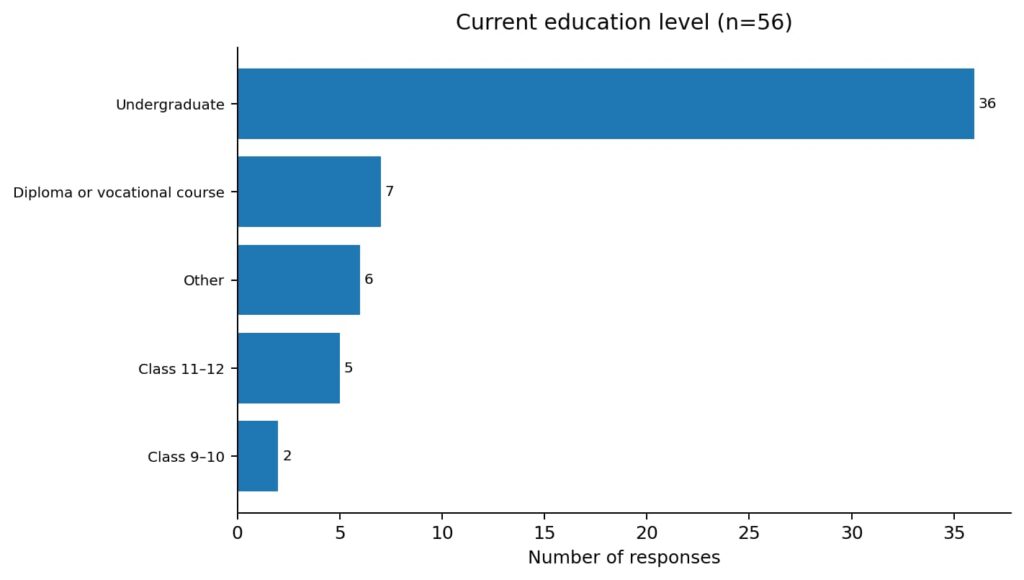
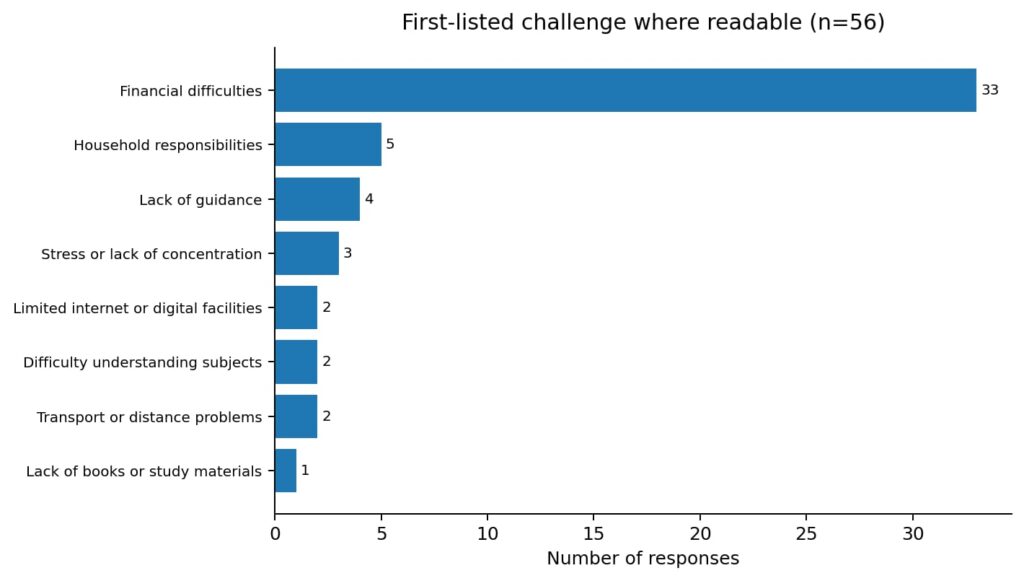
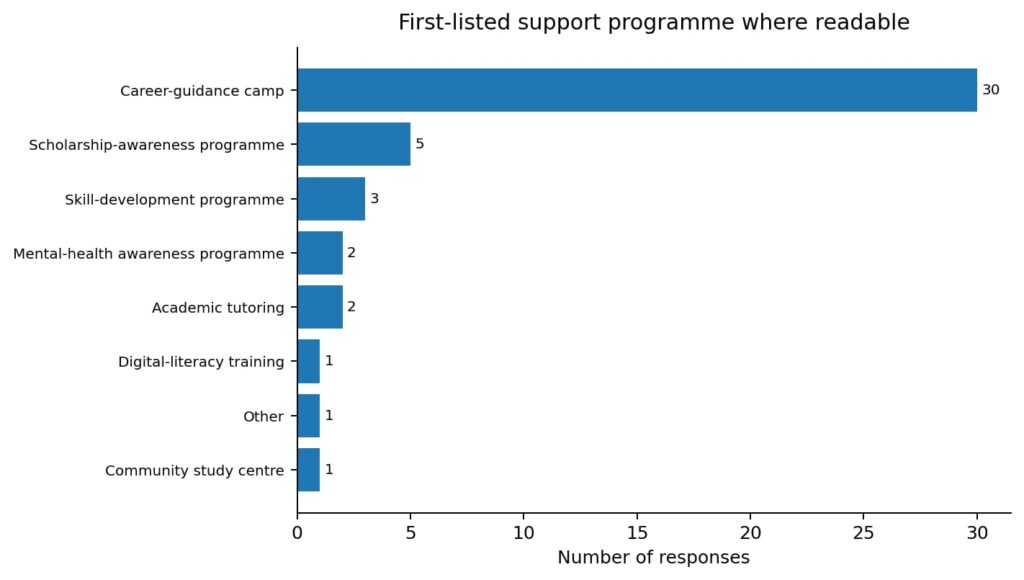
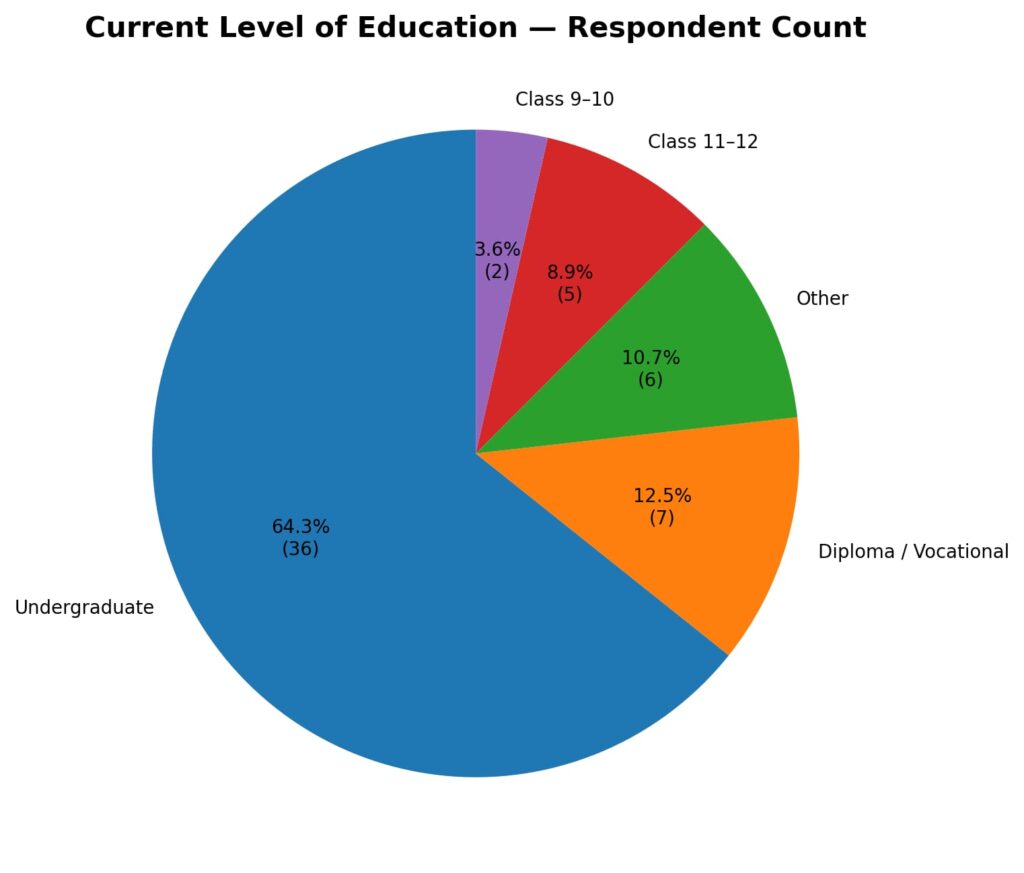
Undergraduates are the largest education group (36, 64.3%). Financial difficulties are the most frequently first-listed readable challenge, while career-guidance camps are the most frequently readable first-listed support programme.
1. Introduction
Education is a major pathway for personal development, employability and social mobility, yet students can face financial, household, digital, academic and guidance-related barriers. This survey was designed to understand the educational difficulties reported by respondents and to identify the types of support programmes they consider useful for continuing and improving their education. The questionnaire captured consent, age group, current education level, major educational challenges, and preferred support programmes.
2. Objectives of the Study
- To identify the major challenges affecting students’ education.
- To understand the educational levels represented among respondents.
- To examine the age-group profile of survey participants.
- To identify support programmes most frequently selected by respondents.
- To provide evidence that can guide future counselling, educational-support and community interventions.
3. Survey Method and Scope
The analysis is based on the uploaded survey-response export. The final analytical sample is 56 consenting respondents.
The exported survey file contains 57 submitted responses. 56 respondents agreed to participate and were included in the analysis; 1 non-consenting response was excluded. Some multi-select response cells in the exported PDF are visibly truncated. Therefore, the challenge analysis uses the first-listed category where it is readable, and the support-programme analysis reports only categories that can be read directly from the export. No attempt has been made to infer truncated selections.
4. Questions Analysis
Question 1 — Participation consent
56 respondents agreed to participate; 1 did not agree and were excluded.
Question 2 — Age group
| Age group | n | % |
| 18–21 years | 28 | 50.0% |
| Above 21 years | 24 | 42.9% |
| 13–15 years | 2 | 3.6% |
| 16–17 years | 2 | 3.6% |
Question 3 — Current level of education
| Education level | n | % |
| Undergraduate | 36 | 64.3% |
| Diploma or vocational course | 7 | 12.5% |
| Other | 6 | 10.7% |
| Class 11–12 | 5 | 8.9% |
| Class 9–10 | 2 | 3.6% |
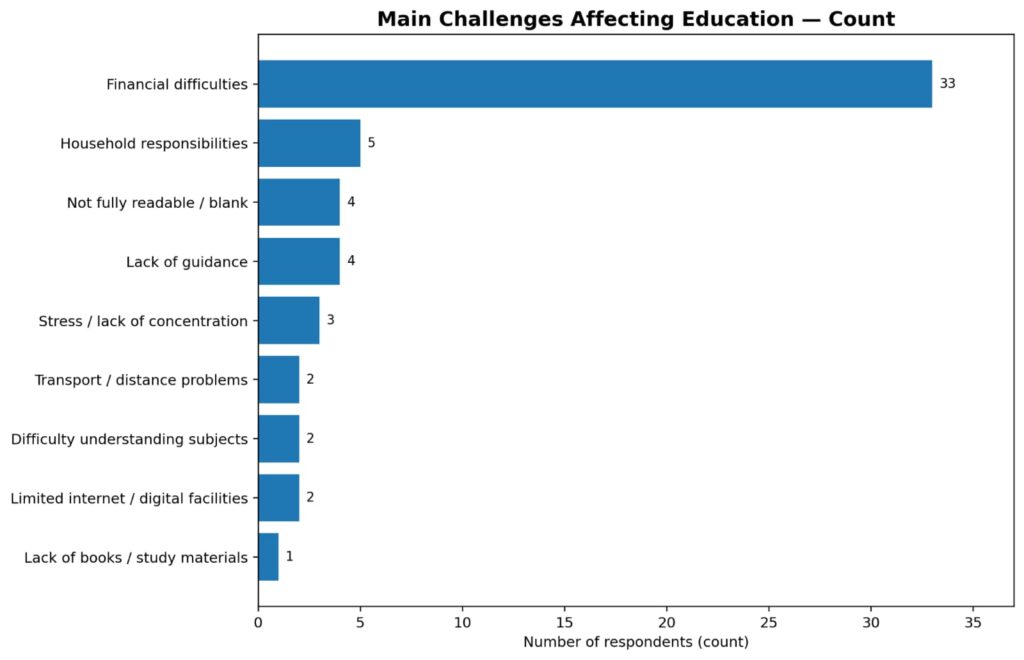
Question — Main challenges affecting education
Because challenge responses are multi-select and some exported cells are clipped, this table counts only the first-listed category when it is directly readable.
| First-listed challenge (readable) | n | % |
| Financial difficulties | 33 | 58.9% |
| Household responsibilities | 5 | 8.9% |
| Lack of guidance | 4 | 7.1% |
| Stress or lack of concentration | 3 | 5.4% |
| Limited internet or digital facilities | 2 | 3.6% |
| Difficulty understanding subjects | 2 | 3.6% |
| Transport or distance problems | 2 | 3.6% |
| Lack of books or study materials | 1 | 1.8% |
| Challenge field not fully readable / blank | 4 | 7.1% |
Question — Support programme preferences
Only support categories that can be read directly from the exported PDF are reported; truncated responses are not inferred.
| Support programme (readable) | n | % of valid responses |
| Career-guidance camp | 30 | 53.6% |
| Scholarship-awareness programme | 5 | 8.9% |
| Skill-development programme | 3 | 5.4% |
| Mental-health awareness programme | 2 | 3.6% |
| Academic tutoring | 2 | 3.6% |
| Digital-literacy training | 1 | 1.8% |
| Other | 1 | 1.8% |
| Community study centre | 1 | 1.8% |
| Support response not fully readable | 11 | 19.6% |
4A. Visual Analysis of Survey Results
5. Key Findings
- Young-adult respondents dominate the sample: 18–21 years accounts for 28 of 56 valid responses.
- Undergraduate respondents form the largest education group: 36 (64.3%).
- Financial difficulties are the most frequent first-listed readable challenge: 33 (58.9%).
- Career-guidance camps are the most frequent readable first-listed support programme.
- Other visible themes include household responsibilities, lack of guidance, stress/lack of concentration, digital limitations, subject-understanding difficulties, transport/distance problems and study-material shortages.
6. Suggested Action Areas
- Periodic career-guidance and counselling camps.
- Scholarship-awareness and financial-support orientation.
- Skill-development and vocational opportunity linkage.
- Academic tutoring or community-based study support.
- Mental-health awareness and stress-management activities.
- Digital-literacy and access-oriented support.
7. Conclusion
The survey offers a useful snapshot of educational challenges and support preferences. The strongest visible themes are financial difficulty and demand for career guidance, alongside needs related to scholarships, skills, academic support, digital access and wellbeing. Future survey rounds should retain the original spreadsheet/CSV as well as the PDF export to enable complete multi-select analysis.

Written By – Nitesh Kumar Verma
Research & Survey Intern at SRRO
“SRRO works as an implementation partner for CSR and social impact projects”