Introduction-
Climate change is a major environmental challenge today. The major causes of climate change include human activities such as burning fossil fuels, deforestation, industrialisation, and pollution. These activities increase greenhouse gas emissions and global warming, hence increasing climate change.
The prevention of climate change mainly includes international policies made by countries through annual COP meetings and agreements like the Paris Agreement, where countries discuss reducing emissions and promoting clean energy. Recent COP meetings have focused on fossil fuels, climate finance, and net-zero goals. India is also contributing through solar energy, electric vehicles, green hydrogen, and by planting trees on large scale, while also aiming to achieve net-zero carbon emissions by 2070.
Literature Review –
Taking a look at literature, a 2023 PIB article explained global climate policies, the Paris Agreement, India’s participation in COP meetings, and its net-zero target for 2070. Articles published by MDPI and Springer explained how reducing deforestation and greenhouse gas emissions can help in the prevention of climate change, while a 2026 BBC article focused on its major causes. Lastly, an Atlantic Council Report highlighted the importance of public awareness and individual decisions in preventing climate change.
Research Gap-
While most existing studies focus on government policies and global climate action, one study briefly highlighted public awareness regarding climate change. However, limited attention has been given to understanding people’s awareness and participation in climate change prevention.
Analysis-
To understand and fill this research gap, a survey was conducted. This survey received 31 responses in total and was aimed at people’s views and perspective on climate change. It was an online survey and responses were open to everyone.
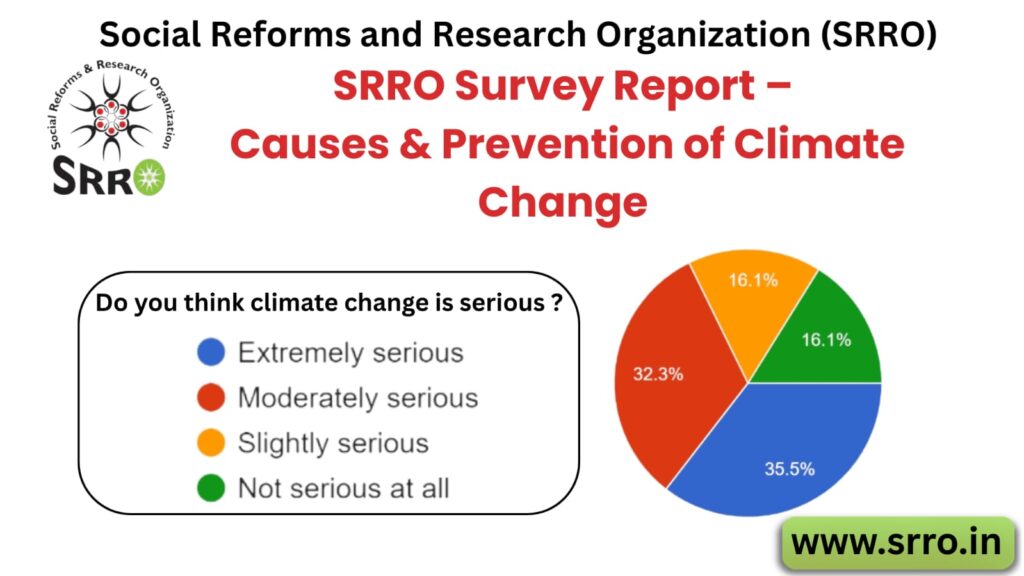
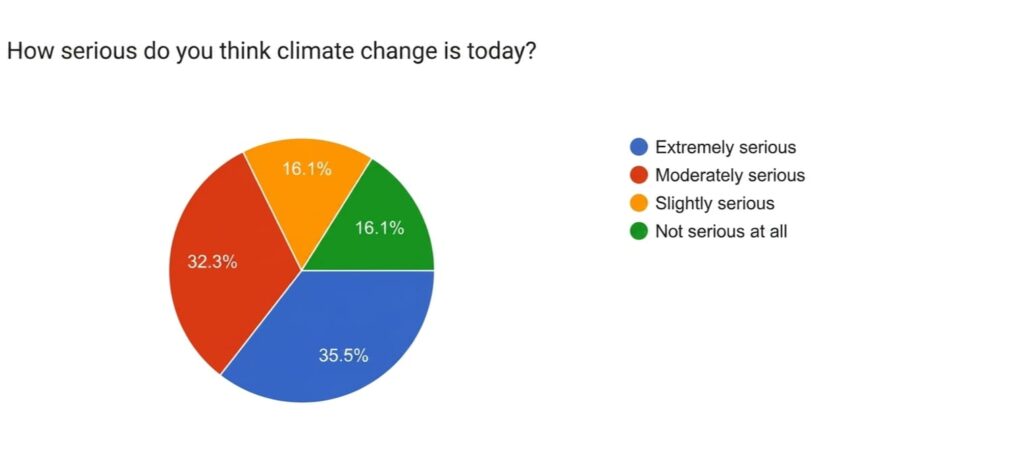
The first look at the survey responses clearly explained that people do take the issue of climate change seriously and they know about it. Around 35.5% of the responders clearly mentioned that climate change is an extremely serious issue.
Apart from that, they also admitted that industrial pollution, deforestation and vehicle emissions are the major causes of climate change. Even though, on ground level, most of the responders may not necessarily stop using vehicles for their daily transport as very small percentage of people have considered using public transport.
Additionally,
they also agreed that human activities contribute the most in global warming, which is a major cause of climate change. All of these, explain that people around us do have awareness regarding the causes of climate change.
When asked about prevention of climate change, the response was in correct direction. A significant number did agree that more tree plantation and reducing plastic use, along with recycling waste may be a good option. A good number of people also voted to conserve electricity. All of these made it clear again, that people have a good idea of what they are supposed to do in order to reduce climate change. This makes a major point that there is again no significant problem in awareness among people regarding prevention of climate change.
But the question remained, that if people know what to do and they also know how serious the problem is, then why is there a gap in action.
The further survey responses cleared this question. When asked about taking responsibility for climate action, a large majority, which was 35.5%, of people voted that the action is responsibility of the government.
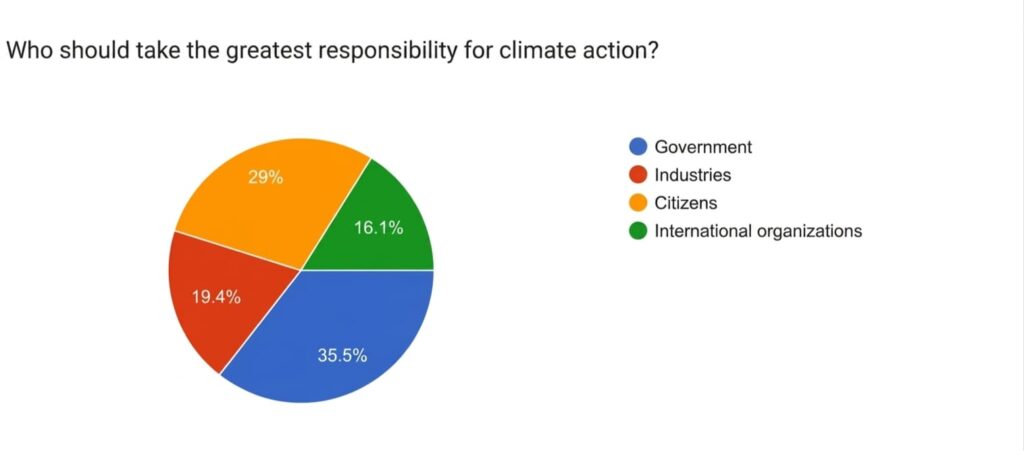
The answer was clear that, people are mostly, waiting for the government to act, before themselves.
Even though, the government has done relevant action within the past few decades, which include various COP conferences around the world, Paris Agreement and our country’s net zero emission target by 2070.
The issue is that all these are global solutions which does not always apply to common people. As the lives of common people are controlled mostly by themselves, especially when it comes to habits like plastic use.
Therefore, unless the people themselves take action, climate change will keep affecting them and they will unknowingly contribute to its causes.
Conclusion-
This article identified a research gap in five published articles and this gap was fulfilled through a dedicated survey, which hence concludes that awareness and action among common people regarding climate change does affect its causes and prevention
References-
- Survey form: https://docs.google.com/forms/d/e/1FAIpQLSdvhIlNzIh_1sWdkh6AlX1r2xe-QL1PhuTGQ7t8ak9Ykvw4xg/viewform?usp=dialoge
- Research Article-
- https://www.bbc.com/news/articles/c9w15nggj58o
- https://www.mdpi.com/2076-3298/10/4/66
- https://link.springer.com/article/10.1007/s10311-020-01059-w
- https://www.pib.gov.in/PressReleaseIframePage.aspx?PRID=1945472®=3&lang=2
- https://www.atlanticcouncil.org/in-depth-research-reports/issue-brief/mapping-public-opinion-to-drive-climate-action-in-india/
Written By – Aditi Ranjan

Research Intern, SRRO
“SRRO works as an implementation partner for Corporate Social Responsibility (CSR ) and social impact projects”