INTRODUCTION-
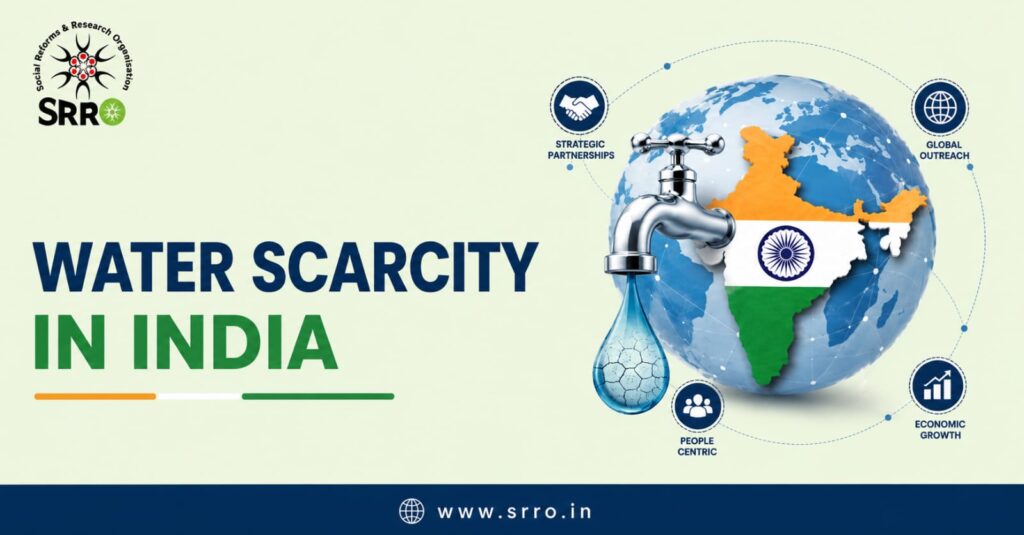
Water is one of the most essential natural resources and is necessary for human life, agriculture, industries, and the environment. Although the Earth has a large amount of water, only a small portion of it is available as freshwater for human use. In recent years, increasing population, rapid urbanisation, pollution, climate change, and excessive use of groundwater have placed great pressure on available water resources. As a result, water scarcity has become a major challenge in many countries around the world.
India is also facing a growing water crisis due to rising demand, uneven distribution of water resources, declining groundwater levels, and changing rainfall patterns. Water scarcity affects not only the availability of drinking water but also agriculture, public health, livelihoods, and economic development. The government has introduced several initiatives to improve water conservation and water management, but the participation of individuals and communities is equally important. Therefore, understanding the issue of water scarcity and promoting responsible water use are essential for ensuring sustainable water resources for present and future generations.
LITERATURE REVIEW-
Existing literature identifies water scarcity as a major challenge influenced by environmental, economic, and governance-related factors. “Water Scarcity” by UN-Water states that water scarcity results not only from limited water resources but also from poor management, unequal distribution, and rising demand. In the Indian context, “Water Crisis in Indian Cities: A Systemic Failure or Wrath of Changing Climate?” (2022) and “Water Crisis of India” (2025) identify urbanisation, climate change, groundwater depletion, pollution, and weak water management as key causes of the country’s water crisis. The economic impact of water scarcity is discussed in “Evaluating the Economic Impact of Water Scarcity in a Changing World” (2021), which highlights its effects on agriculture, industries, and economic growth. Meanwhile, “Development of a New Measure to Check Attitude Towards Water Conservation” (2023) found that although awareness and moral responsibility encourage positive attitudes towards water conservation, they do not always lead to consistent water-saving behaviour.
RESEARCH GAP-
The existing literature primarily focuses on the environmental, economic, and governance aspects of water scarcity, while comparatively less attention has been given to understanding public perceptions and everyday conservation behaviour. Although studies have examined attitudes towards water conservation, there remains limited research exploring the gap between public awareness and consistent water-saving practices. Therefore, the present study seeks to examine people’s experiences, perceptions, and conservation behaviour towards water scarcity, providing a behavioural perspective to the existing literature.
ANALYSIS-
To fill this gap, a survey was conducted. The survey findings suggest that water scarcity is perceived not merely as an environmental concern but also as an issue of governance and resource management. It provides clear patterns regarding public experiences, attitudes, and expectations surrounding water scarcity in India.
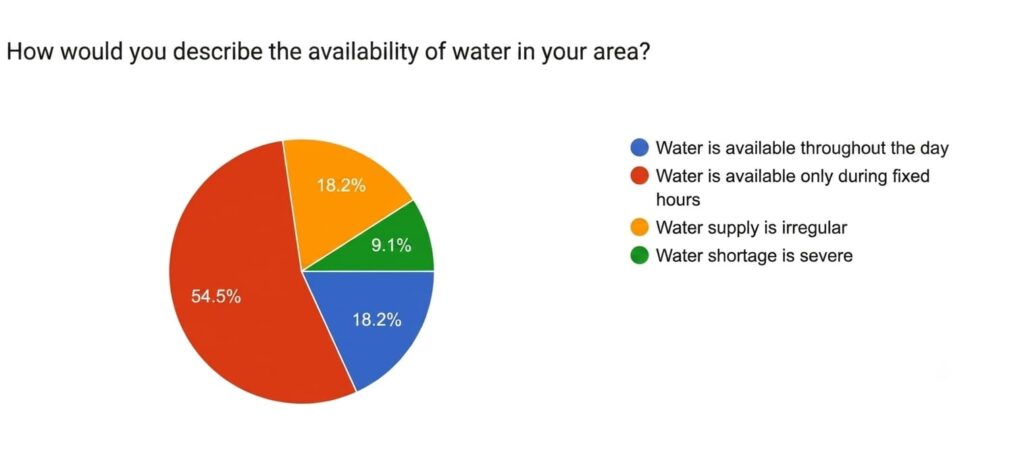
A majority of respondents (54.5%) reported that water is available only during fixed hours, while only a few have access throughout the day. This indicates that many households continue to depend on scheduled water supply rather than continuous access. The presence of respondents experiencing irregular or severe shortages further reflects the uneven distribution of water resources and the need for stronger infrastructure and planning.
Public awareness of the issue appears to be high. Nearly two-thirds of the respondents (63.6%) considered water scarcity a serious issue, while another 18.2% viewed it as extremely serious. At the same time, a small percentage believed it was not a major concern, suggesting that perceptions are often shaped by personal experiences and local conditions.
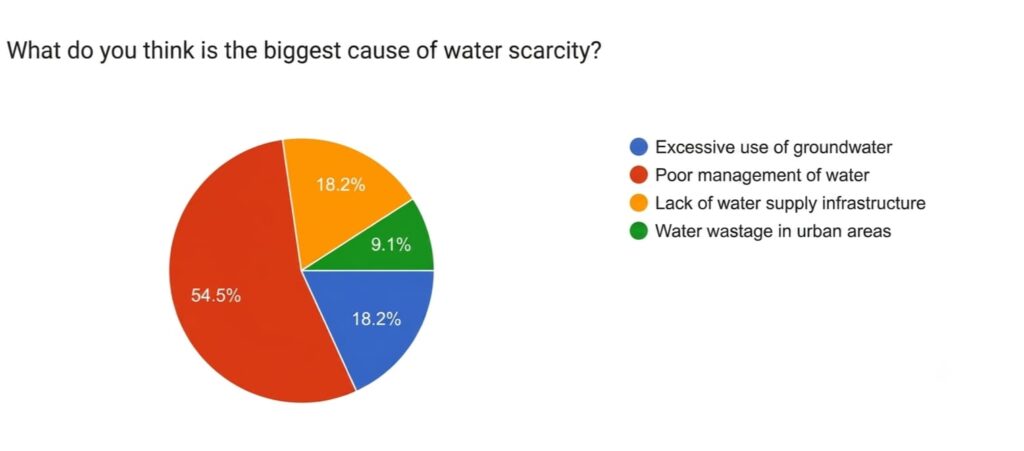
An interesting pattern emerges when examining the perceived causes of water scarcity. More than half of the respondents identified poor water management as the primary reason, while fewer blamed groundwater overexploitation, weak infrastructure, or urban water wastage. This shifts the discussion from the availability of water to the efficiency with which it is managed, indicating that respondents see governance and planning as central to addressing the problem.
The responses also reveal a gap between awareness and behaviour. While most participants reported making efforts to conserve water, they admitted these efforts were not always consistent. This suggests that awareness alone does not necessarily translate into sustained action. Encouraging long-term behavioural change may therefore require not only awareness campaigns but also practical interventions and community participation.
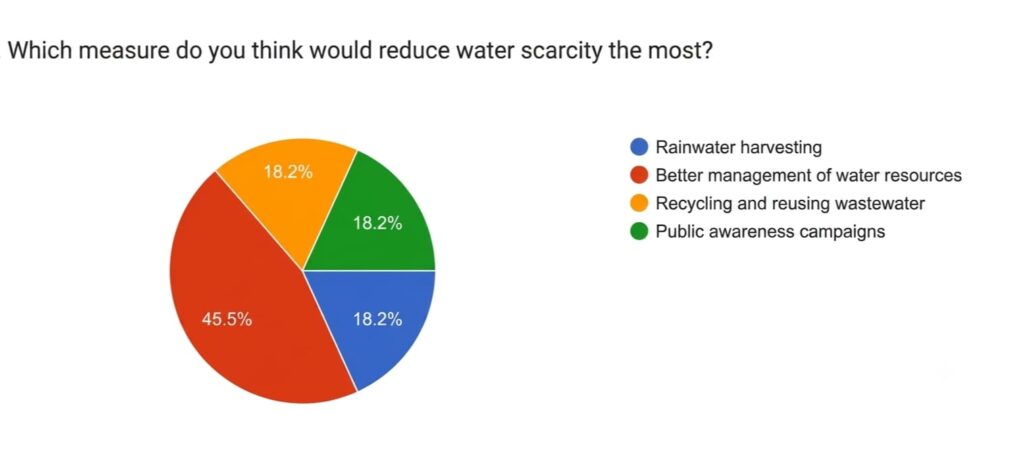
This perspective is reflected in the preferred solutions as well. Nearly half of the respondents believed that better management of water resources would be the most effective measure to reduce water scarcity, while rainwater harvesting, wastewater recycling, and awareness campaigns received comparatively equal support. These responses indicate that respondents favour systemic improvements while also recognising the importance of individual and technological solutions.
Although most respondents experienced water shortages only once or twice during the previous year, these occasional disruptions appear sufficient to influence their perceptions of the issue. At the individual level, rainwater harvesting emerged as the most preferred conservation practice, whereas fewer respondents expressed interest in community-based initiatives. This suggests that people are more willing to adopt household-level measures than collective action, highlighting an area where greater public engagement could be encouraged.
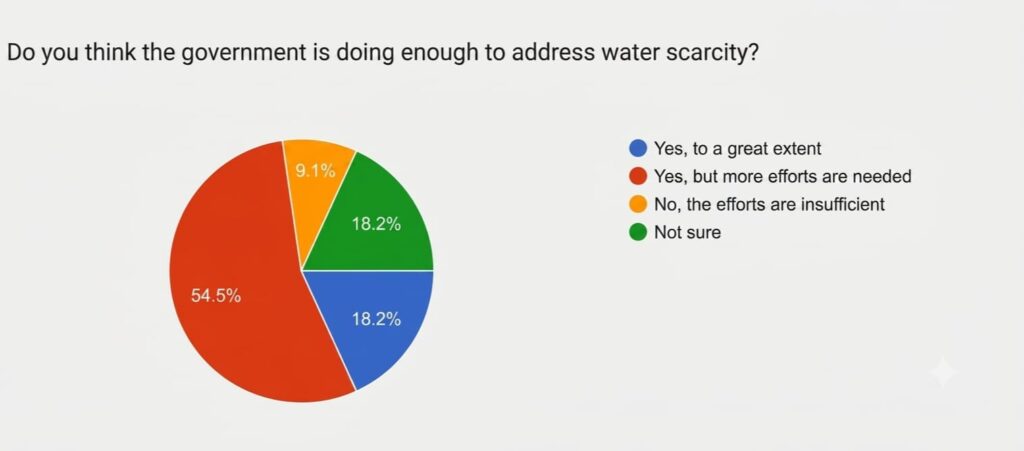
The findings also present a balanced view of government efforts. Most respondents acknowledged that initiatives are being taken but believed that stronger implementation and greater investment are still needed. Rather than expressing complete dissatisfaction, the responses reflect expectations for more effective governance and long-term planning.
Environmental protection emerged as the strongest motivation for conserving water, surpassing financial incentives and legal penalties. This indicates that respondents increasingly view water conservation as an environmental responsibility rather than simply an economic necessity. Consistent with this, a majority also supported stricter laws against water wastage, suggesting that public awareness and regulatory measures are seen as complementary rather than opposing approaches.
Finally, when asked about the government’s highest priority, most respondents favoured protecting rivers and groundwater over expanding infrastructure or enforcing stricter penalties. This reflects an understanding that sustainable water security depends not only on improving supply systems but also on preserving the natural resources that support them.
CONCLUSION-
In conclusion, the survey indicates that respondents view water scarcity as a multidimensional issue shaped by governance, environmental sustainability, and public behaviour. The findings suggest that addressing the problem requires a balanced approach that combines efficient water management, stronger policies, conservation initiatives, environmental protection, and responsible individual practices. The responses received consistently highlight the importance of collaboration between the government and citizens in ensuring sustainable water management in India.
REFERENCES-
- Survey form: https://docs.google.com/forms/d/e/1FAIpQLSexpnYCXhdTCq9_yrWGvqDK9n5Qiocgu73FeDJSUkfzSXJ50w/viewform?usp=dialog
- Articles (Literature review section):
- https://www.unwater.org/water-facts/water-scarcity
- https://nidm.gov.in/PDF/pubs/NIDM_WCIC22.pdf
- https://rjwave.org/jaafr/papers/JAAFR2506009.pdf
- https://www.nature.com/articles/s41467-021-22194-0
- https://pmc.ncbi.nlm.nih.gov/articles/PMC9945790/