
Introduction
Mobile phones have become one of the most integrated technologies into day-to-day life; the question now is whether they are a positive or negative influence in schools. What began as a means of communication between parent and child has evolved into a multifunctional piece of electronics which can both enhance and hinder the educational experience, causing discord between schools, parents, and policymakers about whether mobile phones should even be allowed in classrooms.
To better understand the issue, a public opinion survey was carried out, measuring the stance of students, parents, and teachers on the use of mobile phones in class, whether they are beneficial or not, awareness of formal policy on mobile phone usage, agreement with a total ban during school hours, and an open ended question asking for what they felt was the biggest problem with regards to mobile phones in schools. It was found that while the majority of respondents felt that mobile phones were more harmful than helpful in schools and that they should be banned, few were actually aware of any formal policy regarding the use of mobile phones in schools. Respondents were also asked for what they felt the biggest problem with regards to mobile phones in schools. The largest proportion cited distraction as the main issue, followed by a minority who felt it was a question of academic performance, and safety and communication for parents. This sets up the context for the literature review and research gap, which will be presented below.
Review of Literature
The relationship between cell phone use and schooling has been subjects of academic research for several years, with scholars in pedagogy, psychology, labour economics, and public health contributing to the discussion. The literature can be organized into four key areas: the impact of phones on learning, the efficacy of bans and other restrictions, the perceptions of this issue by stakeholders, and behavioural or well being-related concerns.
Research Gap
While the existing literature offers valuable evidence, several gaps remain that this kind of survey helps illuminate:
- Single-stakeholder designs: Most influential research relies on administrative data or single-group surveys (usually students), with little work capturing students, parents, and teachers together within one institution.
- Limited locally grounded evidence: Existing research on phone dependence and academic outcomes rarely combines policy awareness, ban support, and stakeholder concerns within a single school setting.
- Policy awareness is under-studied: Most studies assess a ban’s effects after implementation but rarely measure whether stakeholders even know a policy exists — this survey suggests awareness can lag well behind expressed concern.
- Gap between concern and support: Respondents who see phones as harmful do not always translate that view into support for a ban, a disconnect the existing literature rarely explores.
- Under-representation of teachers and administrators: Local surveys, including this one, tend to be dominated by student responses, despite reviews suggesting teachers and administrators hold more critical, enforcement-relevant views.
Together, these gaps point to a need for research that balances stakeholder representation, treats policy awareness as its own variable, and examines the gap between perceived harm and support for restriction — the kind of picture this survey begins to sketch, but which a larger, more balanced study would need to confirm.
Research Objectives
- To assess the level of awareness among students, parents, and teachers regarding formal school policies on mobile phone use.
- To examine stakeholder perceptions of whether mobile phones help or hinder classroom learning.
- To gauge the extent of support for a complete ban on mobile phone use during school hours.
- To identify the concerns most commonly associated with mobile phone use in schools, as expressed in respondents’ own words.
Research Questions
- RQ1: How aware are students, parents, and teachers of formal mobile phone policies in their schools?
- RQ2: Do stakeholders perceive mobile phones as more helpful or more harmful to classroom learning?
- RQ3: To what extent do stakeholders support a complete ban on mobile phone use during school hours?
- RQ4: What are the most commonly cited concerns about mobile phone use in schools, and how do they vary by respondent role?
Data Analysis
Responses to closed-ended questions were analysed using descriptive statistics, primarily frequency counts and percentages, to identify overall patterns and areas of consensus or divergence. The open-ended responses were reviewed thematically to identify recurring concerns, such as distraction, academic performance, and safety.
This section presents a chart for each survey question, followed by two parts: what the chart represents, and an evaluation of what it means. All charts are built directly from the 39 valid responses collected
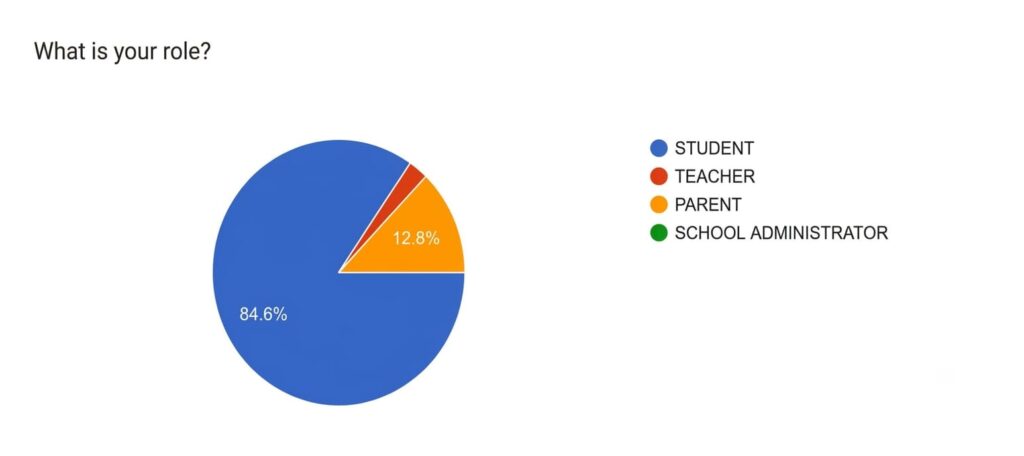
This pie chart shows the composition of the sample by respondent role. Students account for 84.6% , parents for 12.8% , and teachers for just 2.6% . No school administrator responded.
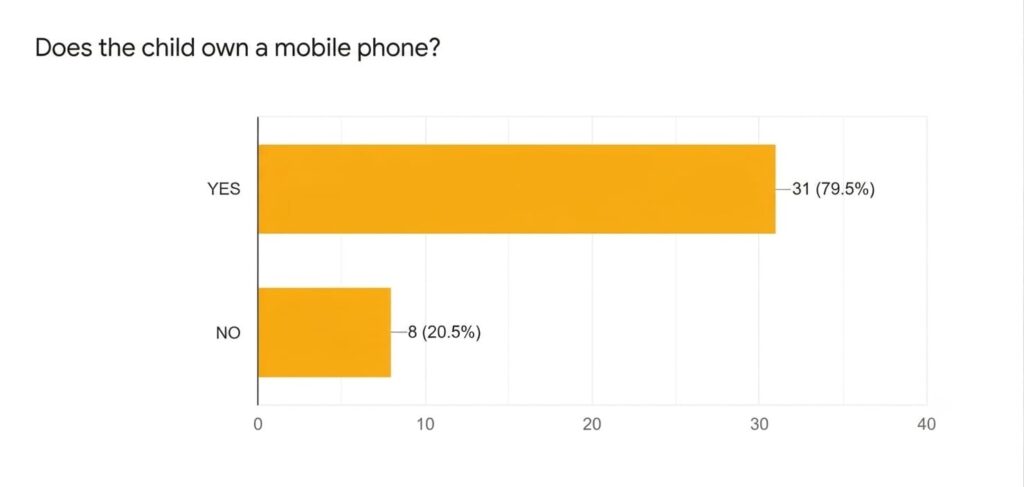
This pie chart shows how common mobile phone ownership already is among the children referenced by respondents: 79.5% own a phone, while 20.5% do not.
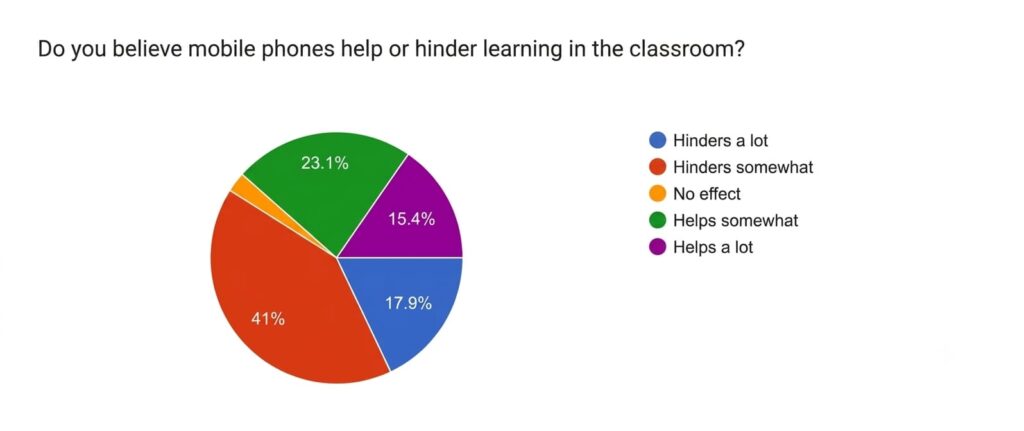
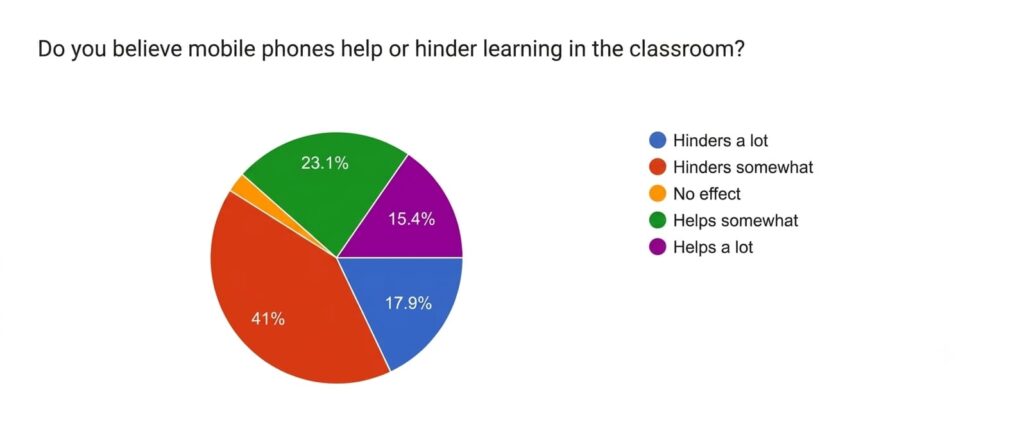
This chart shows opinion spread across five levels, from “hinders a lot” to “helps a lot.” “Hinders somewhat” is the single largest category ( 41%), and combined with “hinders a lot” (, 17.9%), 59% of respondents lean toward viewing phones as harmful to learning. “Helps somewhat” (9, 23%) and “helps a lot” (6, 15%) make up the remaining favourable view, with just 1 respondent reporting no effect.
This pie chart shows awareness of formal school policy on phone use. Only 30.8% confirmed their school has one, while 53.8% said it does not, and 15.4% were unsure.
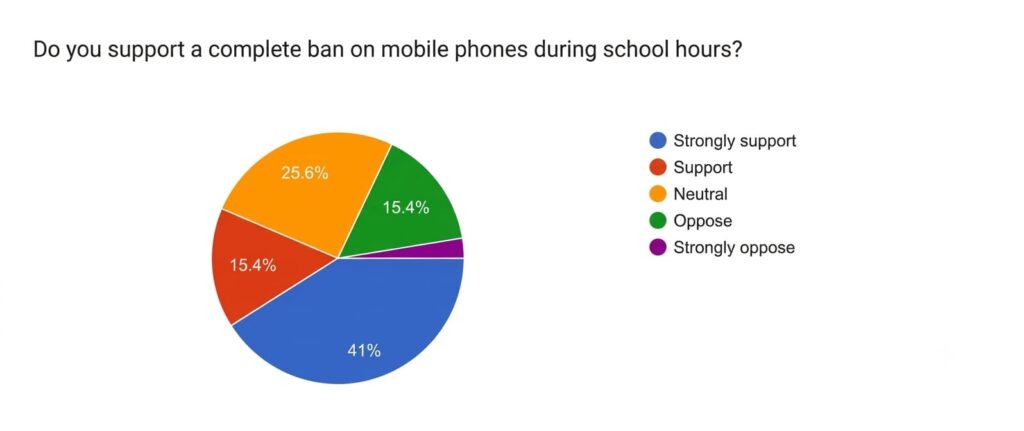
This pie chart shows attitudes toward a complete ban. “Strongly support” is the most common single response (16, 41%), and together with “support” (6, 15%), 56.4% favour a ban outright. Opposition is much smaller — 6 “oppose” and 1 “strongly oppose” (17.9% combined) — while 10 respondents (25.6%) remain neutral.
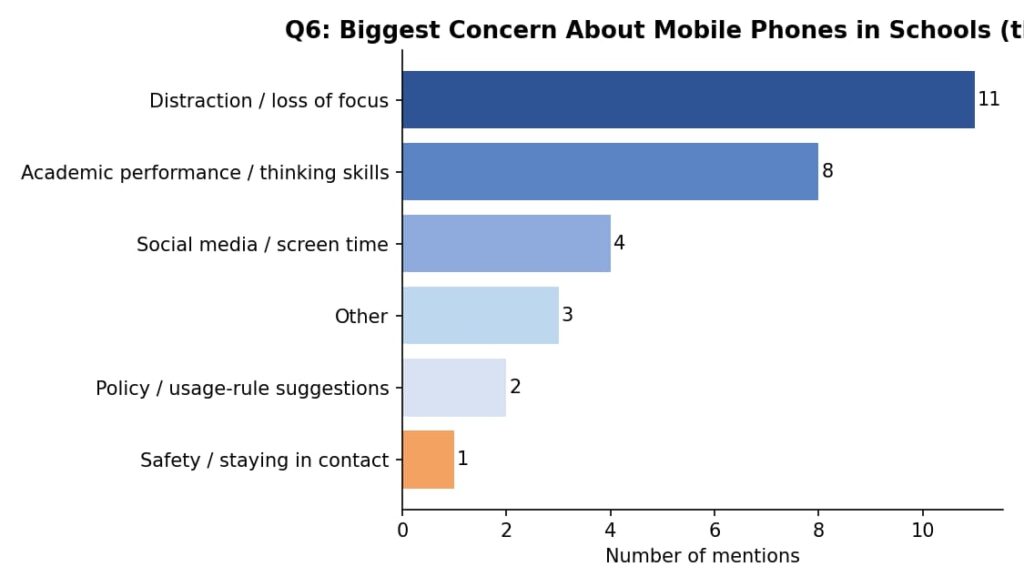
Since this was an open-text question, responses were grouped into themes. “Distraction and loss of focus” was the most frequent (11 mentions), followed by “academic performance and thinking skills” (8), “social media and screen time” (4), “policy or usage-rule suggestions” (2), and a single “safety and staying in contact” mention from a parent
Overall Takeaway
Across all six charts, a consistent story emerges: mobile phone ownership is already near-universal, most respondents lean toward seeing phones as a hindrance to learning, awareness of formal school policy is low, and despite that low awareness, a majority still supports a complete ban during school hours — with distraction as the concern named most often in their own words. The main point of nuance is that opinions on impact are more spread out and moderate than opinions on policy , which are more polarised towards support for restriction , and the sample’s heavy skew towards students means the conclusions speaks most confidently to the student perspective.

–Vanshika
-Survey and research intern
“SRRO works as an implementation partner for CSR and social impact projects”