
Abstract
This report examines perceptions surrounding women’s decisions about marriage, motherhood, and career ambition. Data were collected through a structured survey containing questions on workplace support, social and family expectations, the idea of “having it all,” the influence of a partner’s career ambitions, preferred decision-making approaches, and desired reforms. The dataset contains 12 responses from participants aged 18–24. The findings indicate that workplace support is generally perceived as inadequate: 41.7% described workplaces as minimally supportive and 41.7% as somewhat supportive. Respondents also viewed marriage and motherhood as shaped by both personal choice and social context, while 50% believed that balancing career, marriage, and motherhood is achievable with a perfect support system. Flexible work, childcare, parental leave, and joint decision-making emerged as important measures for creating a more supportive environment.
1. Introduction
Women’s decisions regarding marriage, motherhood, and professional advancement are influenced by multiple, interconnected factors. Although women’s participation in education and employment has expanded, social expectations, unequal care responsibilities, workplace structures, and the timing of family formation continue to affect the choices available to them. The phrase “having it all” often suggests that career, marriage, and motherhood can be combined without conflict; however, the reality may involve institutional support, negotiation, and trade-offs. This survey was designed to understand how young respondents perceive these issues and what changes they consider necessary.
The report focuses on six substantive questions. It does not claim to represent all women or the entire Indian population; rather, it presents the opinions of the participants who responded to the survey.
2. Objectives
- To assess perceptions of workplace support for women combining motherhood with career growth.
- To examine the role of societal and family expectations in decisions about marriage and motherhood.
- To understand attitudes toward the idea of “having it all.”
- To assess the perceived influence of a partner’s career ambitions.
- To identify preferred decision-making approaches and institutional reforms.
3. Methods
A quantitative, descriptive survey design was used. Responses were collected through an online questionnaire and supplied as a PDF export. The dataset included 12 valid responses. Participants were between 18 and 24 years old, with a mean age of 20.25 years. The analysis used frequency counts and percentages. Percentages were calculated using the formula: Percentage = (Number of responses in a category ÷ 12) × 100. Minor spelling variations in the exported responses, such as “amost entirely,” were standardized without changing the meaning.
Limitations: The sample is small and appears to be a convenience sample. Therefore, the findings are indicative rather than generalizable. The survey also records perceptions, not verified workplace policies or personal outcomes.
4. Questions Asked
- Age
- Do you believe workplaces adequately support women who choose to have children while pursuing career growth?
- How much does societal or family expectation shape decisions around marriage and motherhood timings?
- Which statement best reflects your views on “having it all” (career + marriage + motherhood)?
- How much does your partner’s career ambition influence your own decisions about timely marriage and motherhood?
- If you could redesign societal or workplace structures, which of the following would you include?
5. Results
A total of responses were analyzed. The age distribution was: 18 years (1), 19 years (4), 20 years (2), 21 years (3), 22 years (1), and 24 years (1).
5.1 Workplace support
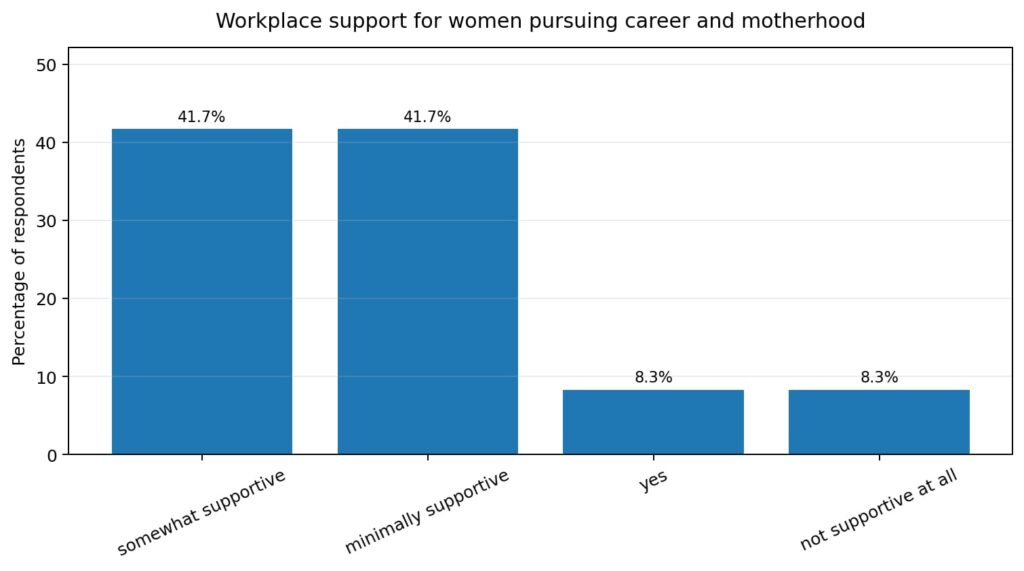
Only one respondent (8.3%) answered “yes” without qualification. Five respondents (41.7%) considered workplaces somewhat supportive, while another five (41.7%) considered them minimally supportive. One respondent (8.3%) felt workplaces were not supportive at all. Overall, 91.7% expressed either qualified or negative views rather than clear confidence in existing support systems.
5.2 Influence of societal and family expectations
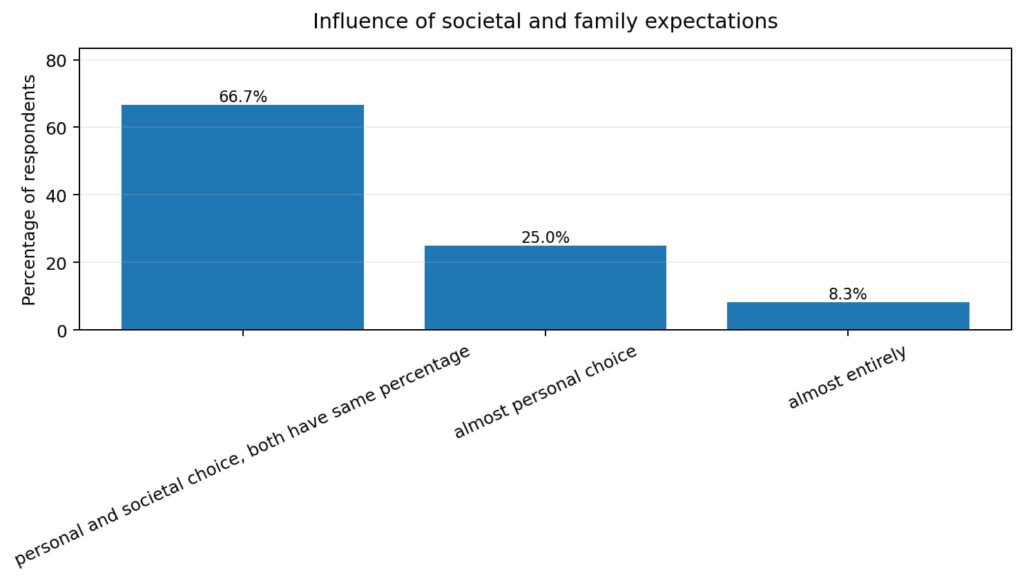
Half of the respondents (50.0%) said that personal and societal choice have equal importance. Four respondents (33.3%) described the decision as almost entirely personal, while one respondent (8.3%) selected “almost entirely” and one response was recorded in a closely related wording. Taken together, the answers suggest that respondents recognize personal agency but do not view decisions as completely detached from social context.
5.3 Views on “having it all”
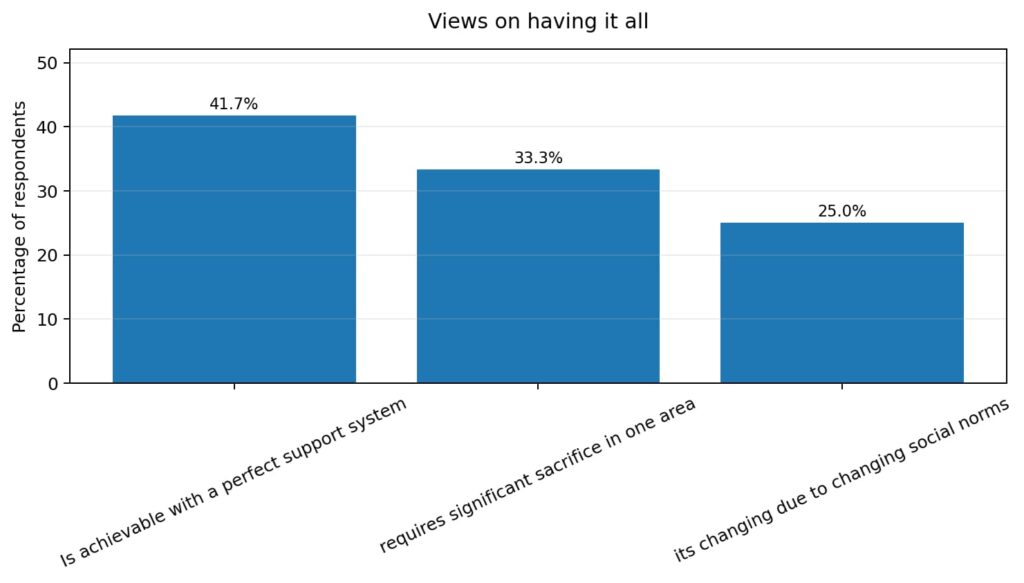
Six respondents (50.0%) believed that combining career, marriage, and motherhood is achievable with a perfect support system. Four respondents (33.3%) felt that it requires significant sacrifice in one area. Two respondents (16.7%) viewed the idea as changing due to changing social norms. The results show that support structures are seen as central to whether balance is possible.
5.4 Influence of a partner’s career ambition
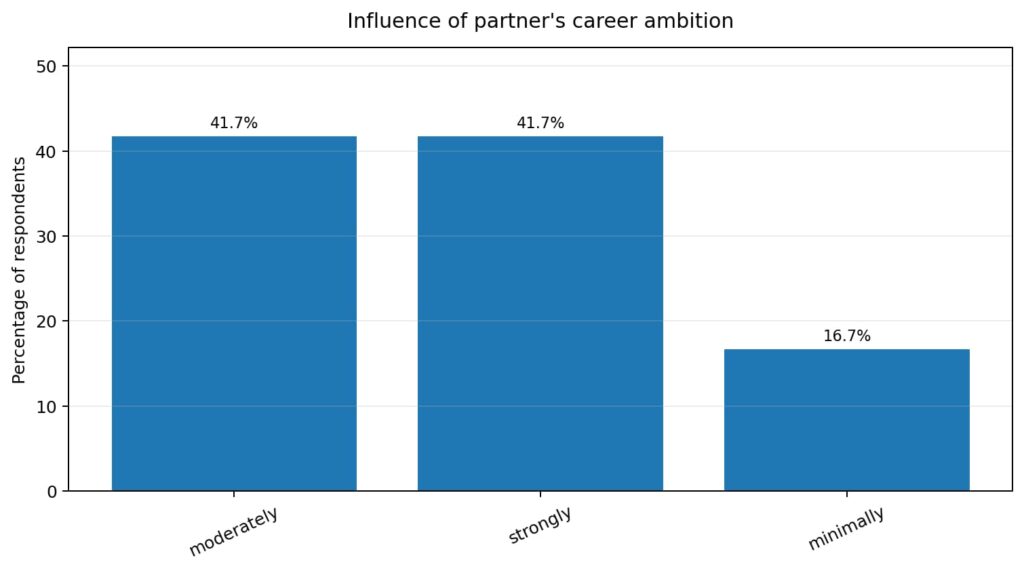
Six respondents (50.0%) reported that a partner’s career ambition strongly influences their decisions. Five respondents (41.7%) reported a moderate influence, while one respondent (8.3%) reported minimal influence. This indicates that partnership dynamics and the coordination of two careers are important considerations.
5.5 Preferred decision-making approach
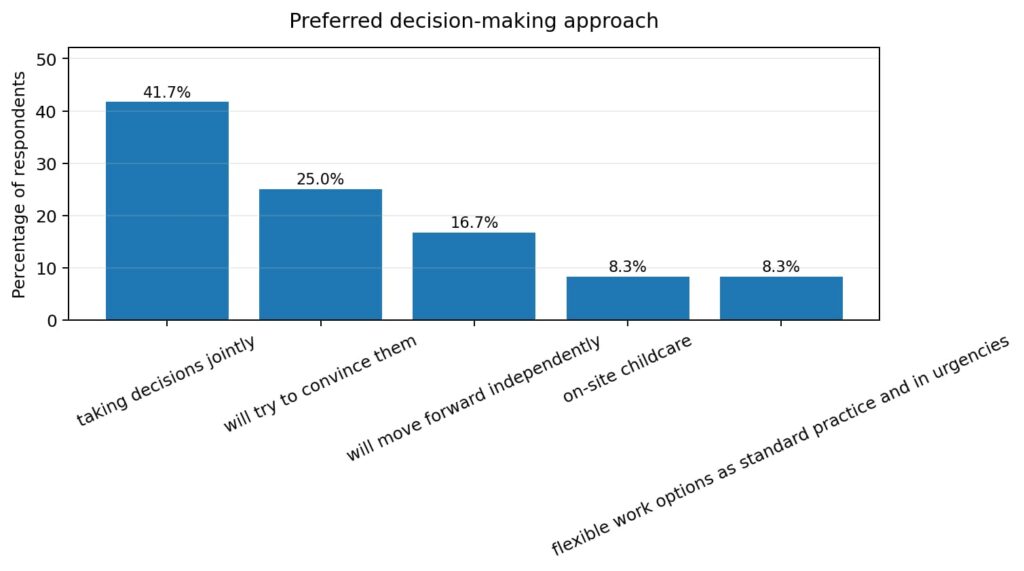
Six respondents (50.0%) preferred taking decisions jointly with their partner. Four respondents (33.3%) said they would try to convince their partner, while two respondents (16.7%) would move forward independently. The most common preference was therefore negotiation and joint decision-making.
5.6 Preferred structural reforms
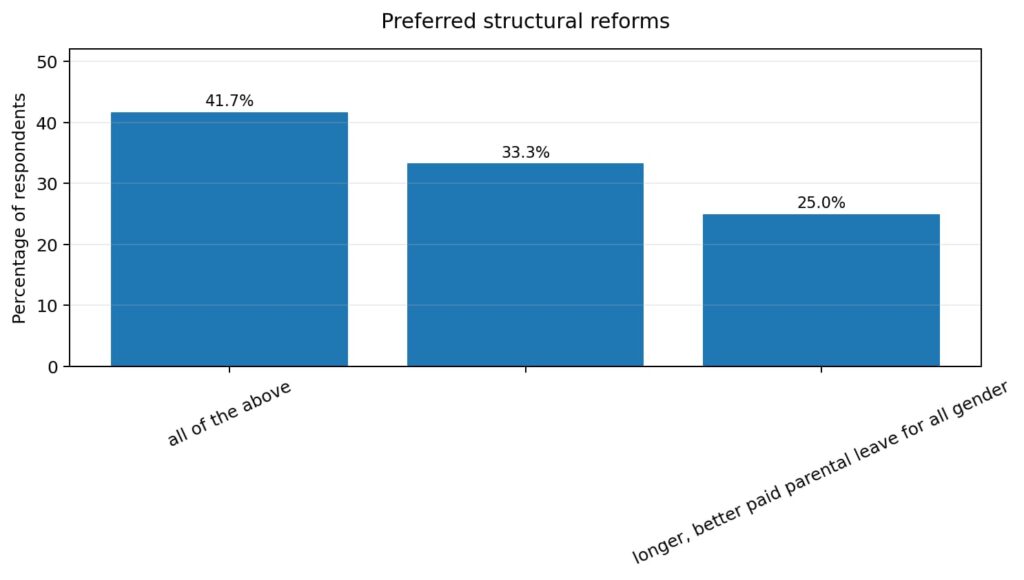
Among the recorded reform responses, “all of the above” appeared most frequently, accounting for 41.7% of responses. Longer, better-paid parental leave for all genders accounted for 25.0%, while on-site childcare and flexible work options were each mentioned by 8.3%. One response was incomplete in the exported data. These answers emphasize that respondents prefer a combination of reforms rather than a single intervention.
6. Discussion
The findings point to a clear gap between the ideal of equal opportunity and respondents’ perceptions of existing support. Although some respondents acknowledged that workplaces are somewhat supportive, the combined share of minimally supportive, not supportive, and qualified responses suggests that institutional arrangements are not considered fully adequate.
The responses concerning social and family expectations show that marriage and motherhood are understood as personal decisions, but not purely individual ones. Half of the participants assigned equal importance to personal and societal choice. This reflects the continuing interaction between individual autonomy and the expectations of families and communities.
Support systems were repeatedly connected to the possibility of “having it all.” Half of the respondents believed that the combination of career, marriage, and motherhood becomes achievable with a perfect support system. This implies that the perceived problem is not necessarily motherhood itself, but the absence of reliable childcare, flexible work, parental leave, and equitable sharing of responsibilities.
The strong or moderate influence of a partner’s career ambition further highlights that women’s choices are shaped within relationships. Joint decision-making was the most preferred approach, suggesting that respondents value partnership, communication, and shared responsibility. However, the presence of responses favoring independent action also indicates that autonomy remains important when mutual agreement is difficult.
Finally, the preference for “all of the above” among reform options suggests that respondents view the issue as structural. No single policy can fully address the career–caregiving conflict; rather, workplace flexibility, childcare, parental leave, and supportive social norms need to operate together.
7. Conclusion
This survey indicates that young respondents generally support women’s autonomy in decisions concerning marriage, motherhood, and career, but they also recognize the influence of social expectations and relationship dynamics. Workplace support is perceived as incomplete, and the possibility of balancing career and family is strongly associated with the availability of a reliable support system. The findings therefore support a broader understanding of women’s empowerment—one that combines individual choice with institutional responsibility.
To make career and family choices more equitable, workplaces and policymakers should prioritize flexible work arrangements, accessible childcare, longer and better-paid parental leave for all genders, and organizational cultures that do not penalize caregiving. At the social level, decision-making should respect women’s autonomy while encouraging shared responsibility between partners and families.

Written By- Pratishtha Gupta
Survey & Research at SRRO
“SRRO works as an implementation partner for CSR and social impact projects”