Introduction-
Government schemes play a vital role in transforming the socio-economic landscape of a nation by providing critical support in education, skill development, employment, entrepreneurship, and healthcare. Across India, numerous government initiatives aim to empower the younger generation and foster self-reliance. However, the effectiveness of these welfare programs relies heavily on public awareness and accessibility.
To evaluate how effectively these initiatives reach their target audience, the Social Reforms & Research Organisation (SRRO) conducted a comprehensive Public Awareness Survey on Government Schemes for Youth. This study provides key insights into youth perception, awareness levels, core challenges, and actionable pathways to maximize benefit distribution.
Overview of Key Government Schemes for Youth
Is Before examining the survey results, it is important to highlight the primary government programs designed to foster youth empowerment, financial inclusion, and skill advancement:
-Pradhan Mantri Mudra Yojana (PMMY): Provides micro-finance and collateral-free loan assistance to small businesses and budding entrepreneurs.
-PM Kaushal Vikas Yojana (PMKVY): Focuses on skill training and industry-relevant certification to generate employment opportunities.
-Stand-Up India Scheme: Promotes entrepreneurship among women and SC/ST communities through structured bank loans.
-PM Jan Dhan Yojana (PMJDY): Ensures universal financial inclusion by offering every household direct banking access and financial security.
-Ayushman Bharat Yojana: Offers healthcare security and free secondary and tertiary hospital treatment to vulnerable families.
-Digital India Initiative: Focuses on digital literacy, online infrastructure, and accessible digital governance services.
Demographic Profile of Survey Participants
To ensure a structured analysis, the survey recorded responses across various age groups, focusing primarily on young adults preparing for higher education or entering the workforce.
Age Distribution Analysis
The demographic data revealed a strong representation of youth in their early twenties:
18 Years: Represents 7.1% of total respondents (1 participant).
20 Years: Represents 28.6% of total respondents (4 participants).
21 Years: Represents the largest segment at 42.9% (6 participants).
22 Years: Represents 14.3% of total respondents (2 participants).
37 Years: Represents 7.1% of total respondents (1 participant).
Overall, 85.8% of participants belonged to the core youth age bracket of 20 to 22 years, offering a precise reflection of how current students and job seekers perceive government welfare initiatives.
Perceived Primary Purpose of Youth Schemes
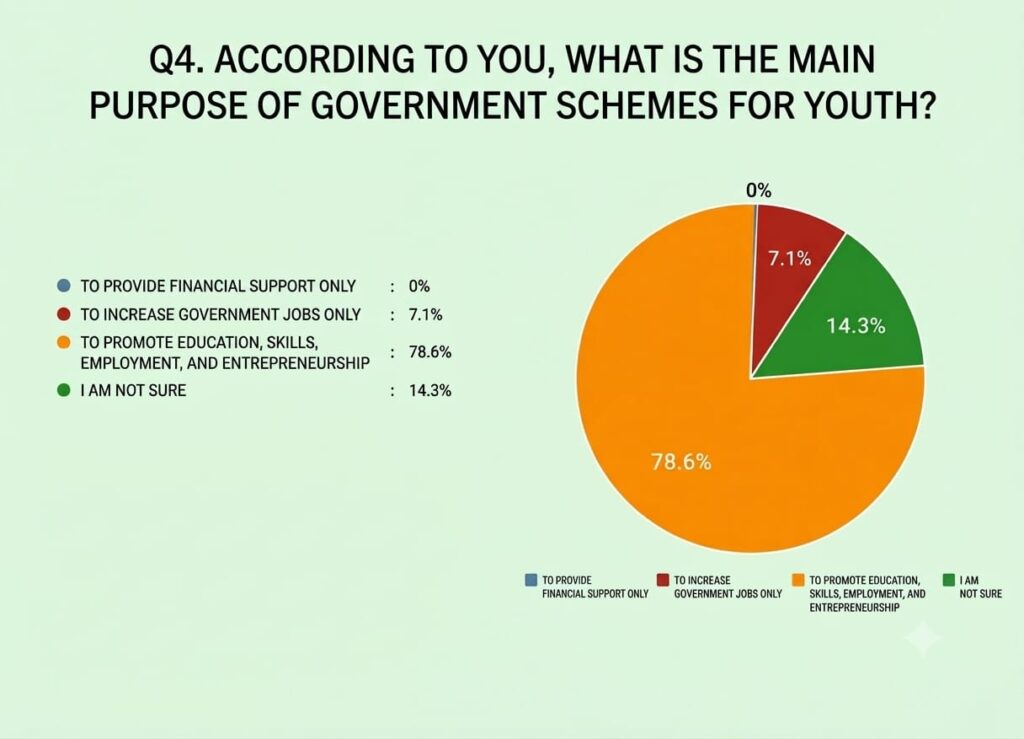
Understanding how citizens view the intent behind public programs is critical for evaluating policy messaging. When asked about the main purpose of government schemes for youth, respondents provided the following insights:
-Education, Skills, Employment, and Entrepreneurship: A overwhelming majority of 78.6% recognized that these schemes aim to promote holistic youth development, employment creation, and skill enhancement.
-Increasing Government Jobs Only: Only 7.1% believed the primary objective was strictly limited to government job creation.
-Financial Support Only: 0% of respondents viewed these schemes as purely monetary handouts.
-Unsure: Meanwhile, 14.3% of respondents remained uncertain about the primary goals of these programs.
Consequently, these results demonstrate that most citizens correctly recognize youth-centric policies as tools for broad structural empowerment rather than short-term relief.
Biggest Challenges in Scheme Implementation
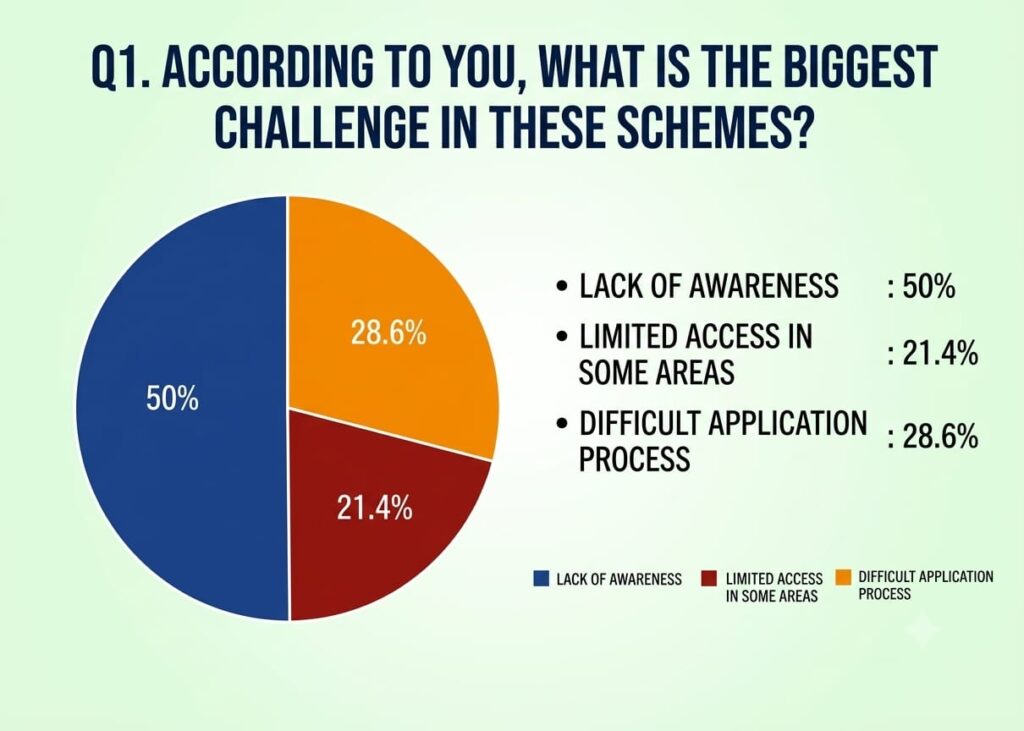
Despite widespread appreciation for these policies, eligible individuals face substantial roadblocks when attempting to access benefits. The survey identified three primary challenges:
-Lack of Awareness (50.0%): Half of all respondents identified insufficient information and poor outreach as the single biggest barrier. Many eligible citizens simply do not know which programs exist or how to qualify.
-Difficult Application Process (28.6%): Complex paperwork, lengthy verification procedures, and bureaucratic hurdles deter many young applicants.
-Limited Access in Some Areas (21.4%): Geographical barriers and limited regional infrastructure prevent equitable distribution, particularly in rural or semi-urban locations.
Thus, addressing these administrative and operational bottlenecks is essential to bridge the gap between policy formulation and ground-level execution.
Perceived Benefit Reach Among Youth
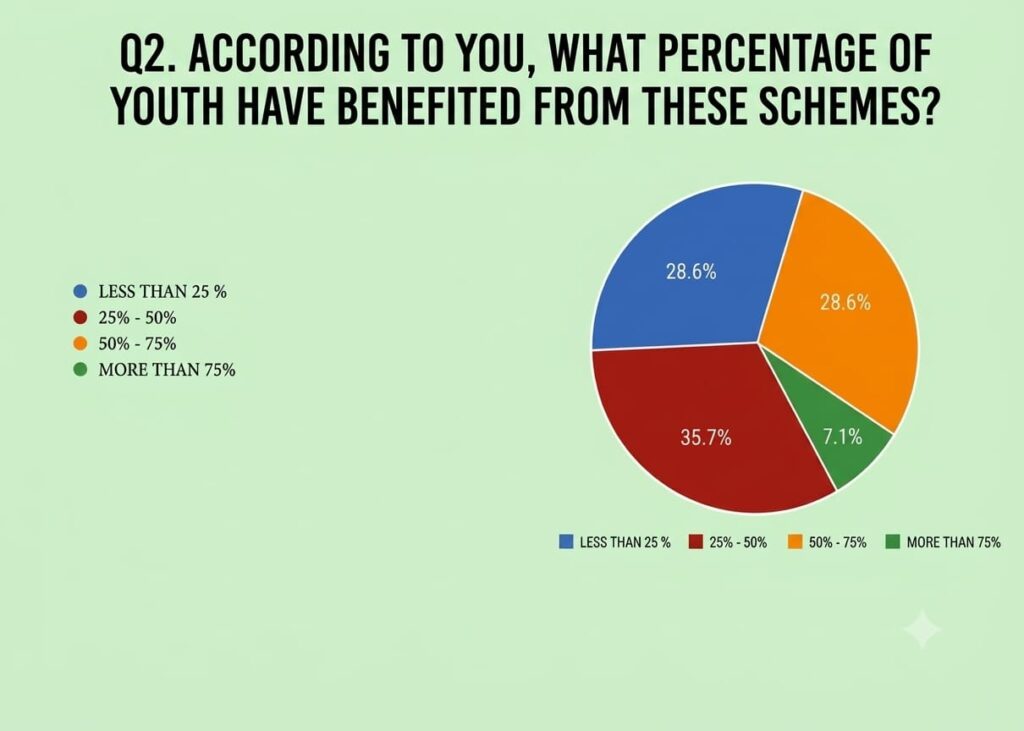
When evaluating the actual impact of government schemes, respondent opinions varied regarding the percentage of young people who have successfully benefited:
-25% to 50% Benefited: The largest group, 35.7% of respondents, felt that between a quarter and a half of eligible youth have received scheme benefits.
-Less than 25% Benefited: Equally, 28.6% believed that less than a quarter of the target population has gained meaningful assistance.
-50% to 75% Benefited: Another 28.6% held a more optimistic view, estimating that up to three-quarters have benefited.
-More than 75% Benefited: Only a small minority of 7.1% believed that scheme reach exceeds 75%.
In summary, while a significant portion of youth is benefiting, popular perception indicates that outreach remains constrained and incomplete.
Who Benefits the Most?
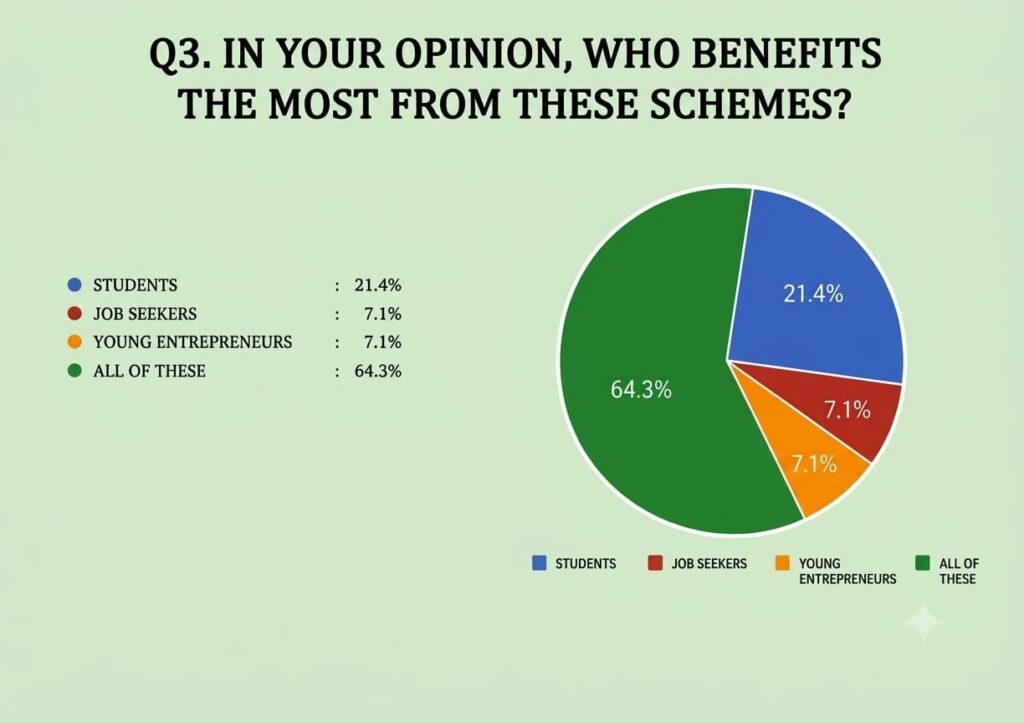
The survey also examined public perception regarding which specific youth categories derive the maximum advantage from available schemes:
-All Groups (Students, Job Seekers, Entrepreneurs): A dominant 64.3% expressed that schemes are broadly inclusive and benefit all segments.
-Students: 21.4% felt that students are the primary beneficiaries due to education and scholarship programs.
-Job Seekers: 7.1% identified job seekers as the main beneficiaries.
-Young Entrepreneurs: 7.1% believed young entrepreneurs benefit the most through startup funding and business loans.
Key Recommendations for Policy Improvement
To enhance the overall efficacy, reach, and usability of youth schemes, survey participants suggested several crucial improvements:
-Simplify Application Procedures: Streamline bureaucratic steps, minimize paper documentation, and make online registration portals user-friendly.
-Expand Awareness Campaigns: Utilize dynamic digital platforms, social media, and localized offline campaigns to inform citizens about available benefits.
-Focus on Practical Skill Training: Align training initiatives with real-world industry demands to boost immediate youth employability.
-Increase Financial & Career Opportunities: Offer wider access to scholarships, paid internships, entry-level job opportunities, and startup incubation grants.
-Improve Ground Implementation: Strengthen tracking mechanisms to ensure schemes are transparent, timely, and accessible to every deserving citizen.
Conclusion
The Public Awareness Survey by the Social Reforms & Research Organisation (SRRO) underscores both the potential and the current limitations of government schemes for youth. While young citizens broadly understand the purpose of these programs, persistent barriers like complex application procedures and limited awareness prevent many from receiving their entitled benefits.
By simplifying application channels, expanding targeted awareness campaigns, and integrating practical skill development, policymakers and grassroots organizations can ensure that government welfare reaches every eligible young citizen—paving the way for an empowered, self-reliant nation.

Written By- Anamika
SRRO Intern
“SRRO works as an implementation partner for Corporate Social Responsibility (CSR) and social impact projects”