INTRODUCTION-
Noise pollution is one of the most common yet under addressed environmental issues in urban areas. People experience it in their daily lives through traffic, construction activities, loudspeakers, and other sources. Yet, it often receives less attention than other forms of pollution.
As cities continue to expand and everyday noise levels increase, concerns regarding its impact have also grown. Understanding the issue and its place in everyday life is therefore, important in addressing the broader challenges associated with environmental pollution.
LITERATURE REVIEW-
The article, Environmental Noise Exposure and Health Outcomes: An Umbrella Review of Systematic Reviews and Meta-Analysis highlight the adverse health effects of noise pollution, including stress and sleep disturbances. Another article, Evaluation and Analysis of Environmental Noise Levels in NCT of Delhi, India identifies traffic and honking as major contributors to urban noise pollution. Above that, A Retrospective View of Noise Pollution Control Policy in India: Status, Proposed Revisions and Control Measures discuss India’s noise-control regulations and the need for stronger implementation. Apart from that, Awareness and Learning in Participatory Noise Sensing emphasizes the role of public participation in increasing awareness, while Knowledge and Perception Regarding the Prevention of Traffic Noise Pollution Among Students of North Karnataka highlights the importance of education and awareness in preventing noise pollution. Together, these studies provide insight into the health impacts, causes, regulations, and public perceptions associated with noise pollution.
RESEARCH GAP-
Existing studies on noise pollution have focused on its causes, health impacts, public awareness, and government regulations. While these studies explain the nature of the problem and the measures required to control it, less attention has been given to whether awareness actually influences behaviour. In particular, there is limited research on whether people who are aware of noise pollution and its consequences, see themselves as contributors to the problem and take action to address it. This study seeks to address this gap by examining the relationship between awareness, personal accountability, and action in the context of noise pollution.
ANALYSIS-
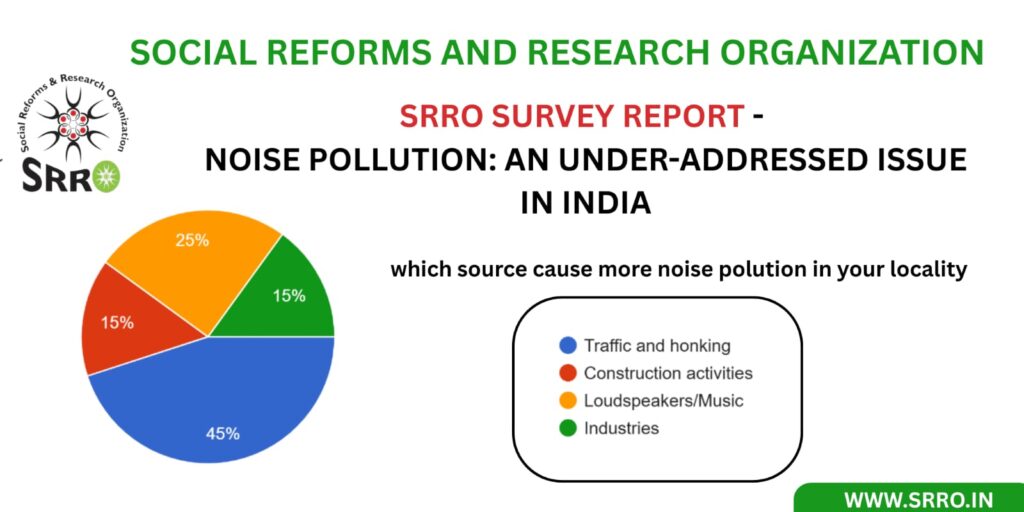
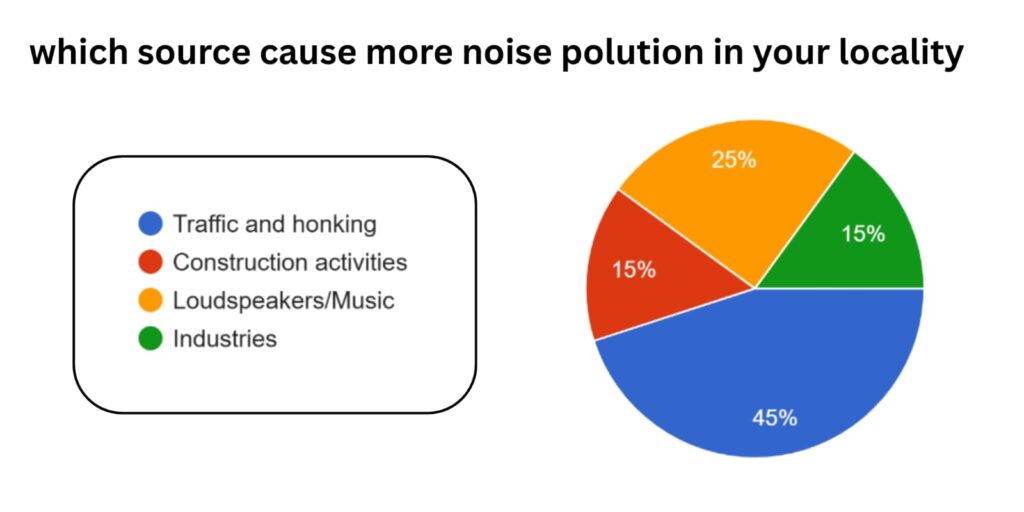
To fill this gap, an online survey was conducted. The survey findings indicate that respondents generally recognise noise pollution as a significant environmental issue. A considerable percentage of respondents viewed noise pollution as a serious concern, with 20% considering it extremely serious and 50% believing that it is serious at least sometimes. Furthermore, 45% of respondents identified traffic and honking as the primary source of noise pollution in their locality, pointing towards one of the biggest contributors to the problem.
The Government of India has introduced several laws and regulations to control noise pollution. When respondents were asked about their awareness of these laws, 25% stated that they were fully aware, while another 40% reported being aware to some extent. This means that a large majority of respondents are not completely unfamiliar with the legal side of the issue. However, when asked whether anti-honking rules are followed on roads, 40% believed that they are rarely followed and another 20% believed that they are never followed. This creates an interesting observation. People seem to know that rules exist, yet they also believe that those rules are not being followed in practice.
This naturally raises another question. If people are aware of noise pollution laws, recognise honking as a major contributor to noise pollution, and know that rules against unnecessary honking are not being followed, then why does the behaviour continue?
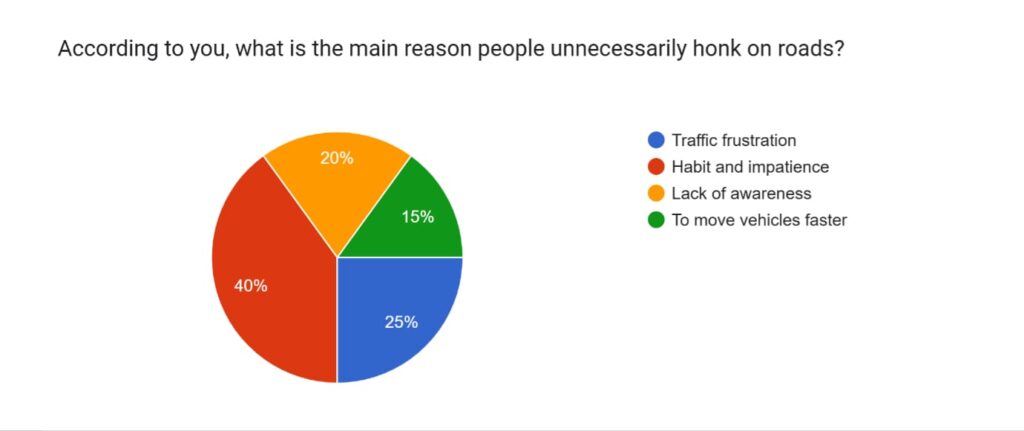
The answer becomes clearer when looking at what respondents believe causes unnecessary honking in the first place. A significant 40% view it to be habit and impatience, while 25% pointed towards traffic frustration. Another 20% believed that it happens because of a lack of awareness. Interestingly, only 15% felt that people honk mainly to make vehicles move faster. This suggests that respondents do not see excessive honking as something that happens out of necessity. Instead, they see it as a behavioural issue that has become normalised on the roads.
Yet another question emerges from this finding. If people themselves believe that unnecessary honking is mainly driven by impatience, frustration, and habit, then why is nobody stopping and questioning their own behaviour?
The answer may lie in the way people perceive their own role in the problem. When respondents were asked whether they had personally contributed to noise pollution through unnecessary honking, 45% stated that they had done so only rarely, while 10% claimed that they had never contributed at all. This points towards an issue of accountability. People recognise that unnecessary honking is common on roads, but many do not seem to place themselves at the centre of the problem.
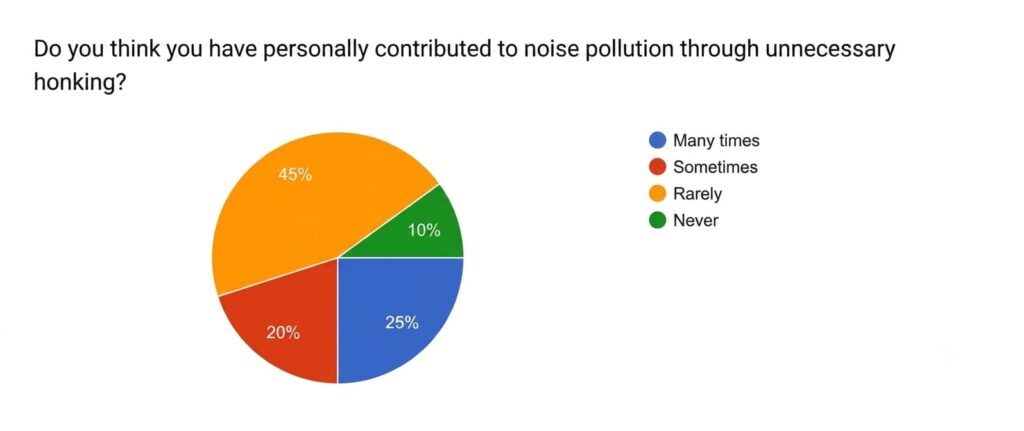
One possible explanation is that people often believe that it is the other person who honks excessively. They see noise pollution around them, they hear unnecessary honking around them, and they believe that rules are not being followed around them. Yet, when it comes to their own behaviour, they are far less likely to view themselves as major contributors. In this way, responsibility gets shifted from the individual to society. Everyone agrees that the problem exists, but the problem is always associated with someone else.
The next question that emerges from these findings is how this problem can be reduced. The survey responses suggest that people largely support government intervention. A combined 70% of respondents agreed that fines and penalties can help reduce noise pollution. Public awareness campaigns were considered the most effective government measure by 40% of respondents, while 50% supported increased monitoring of noise pollution in public places.
While support for government intervention was high, only 15% reported frequently taking action by filing complaints or reporting noise pollution. Although 50% had taken action once or twice, many respondents had either never taken action or had only considered doing so.
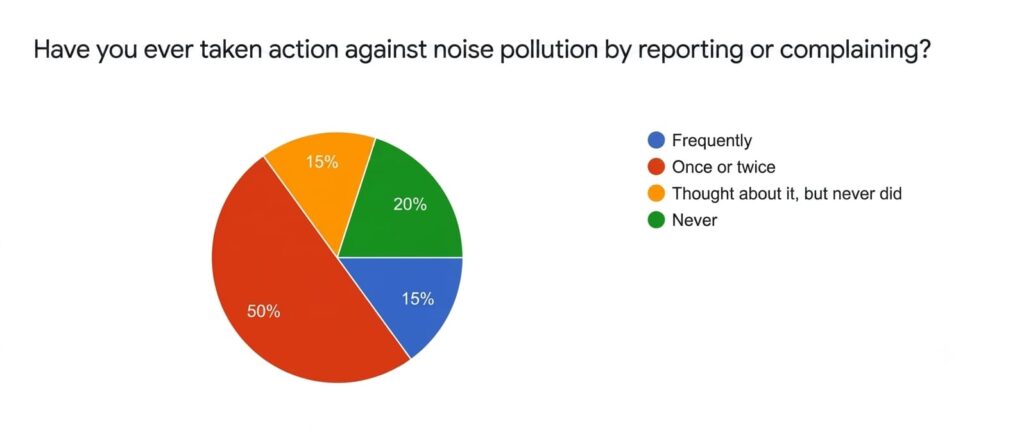
This points towards a gap between awareness and action. People recognise the problem, understand its causes, and support solutions aimed at reducing it. Yet, when it comes to taking action themselves, participation remains limited. This may help explain why noise pollution continues to remain a common issue despite growing awareness about it. Rules, penalties, and awareness campaigns can certainly help, but their impact is likely to remain limited if people do not actively participate in the process. A problem created through everyday behaviour cannot be solved by regulations alone, it also requires everyday action and cooperation from the public.
CONCLUSION-
This article addressed a gap in existing five research articles by examining whether awareness of noise pollution actually translates into personal accountability and action. The findings suggest that while awareness regarding noise pollution is relatively high, it does not always influence behaviour. Many respondents recognised the problem and supported measures to control it, yet fewer saw themselves as contributors or took regular action against it. The article therefore concludes that awareness alone is not enough, reducing noise pollution also requires greater personal accountability and active public participation.
REFERENCES-
- Survey form:
- Research articles:
- https://pmc.ncbi.nlm.nih.gov/articles/PMC11314258/
- https://pmc.ncbi.nlm.nih.gov/articles/PMC9869818/
- https://npl.csircentral.net/2134/
- https://pubmed.ncbi.nlm.nih.gov/24349102/
- https://www.ijcmph.com/index.php/ijcmph/article/view/1277