1. Introduction
Women’s participation in education and employment has increased, but career choices are still influenced by family expectations, social attitudes, safety concerns and the availability of support. This survey was conducted to understand people’s views about women choosing a career, equal employment opportunities, the role of women in society, and the possibility of balancing work and family responsibilities.
2. Objectives of the Survey
- To understand public opinion on women’s freedom to choose a career.
- To examine views about the role of women in society.
- To understand support for equal employment opportunities for women and men.
- To identify major obstacles that may prevent women from working.
- To understand whether people believe working women can balance career and family responsibilities with adequate support.
3. Methodology
The survey was conducted using an online Google Form. A total of 32 responses were received. The responses were represented through pie charts and were analysed to identify the main trends and opinions expressed by the respondents. The findings describe the views of the respondents and should not be treated as a representation of the entire population.
4. Survey Findings and Analysis
4.1 Freedom to Pursue a Career
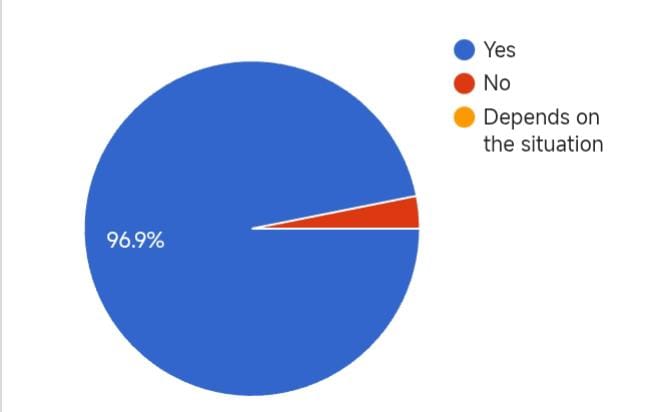
The responses show very strong support for women having the freedom to pursue a career according to their wishes. Out of 32 respondents, 31 respondents (96.9%) selected “Yes”, while 1 respondent (3.1%) selected “No”. No respondent selected the situation-dependent option. This indicates that almost all respondents in this survey consider personal choice in career decisions important for women.
4.2 Role of Women in Society
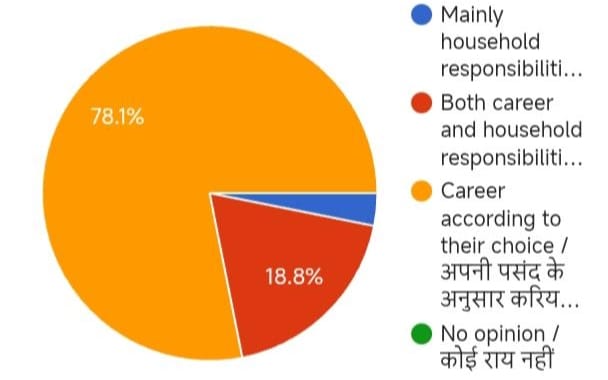
The largest share of respondents, 25 out of 32 (78.1%), expressed the view that women should be able to choose their career according to their own preference. Six respondents (18.8%) viewed women’s role as involving both career and household responsibilities, while one respondent (3.1%) selected mainly household responsibilities. No respondent selected “No opinion”. The responses therefore show that personal choice in career is the most commonly expressed view, while balancing career and household responsibilities is also recognised by some respondents
4.3 Equal Employment Opportunities
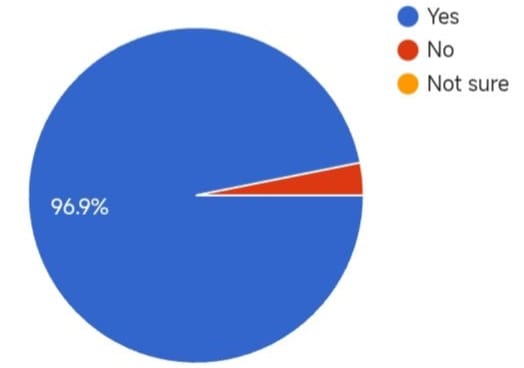
The survey indicates strong support for equal employment opportunities for women and men. Thirty-one respondents (96.9%) answered “Yes”, while one respondent (3.1%) answered “No”. No respondent selected “Not sure”. This suggests that equal access to employment is widely supported among the respondents
4.4 Major Obstacles to Women’s Employment
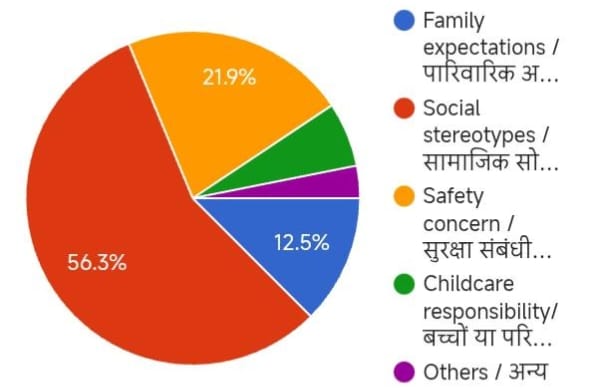
Social stereotypes were identified as the most commonly selected obstacle, with 18 respondents (56.3%) choosing this option. Safety concerns were selected by 7 respondents (21.9%), while family expectations were selected by 4 respondents (12.5%). Childcare responsibilities accounted for 1 response (3.1%), and another 1 respondent (3.1%) selected the “Others” category. The responses suggest that social attitudes and stereotypes were considered the most significant barrier among the options provided.
5. Overall Analysis
The overall responses show a strong positive attitude towards women’s participation in employment and their freedom to make career choices. Most respondents supported women having the freedom to pursue a career and supported equal employment opportunities for women and men. At the same time, the responses show that social stereotypes, safety concerns and family expectations are perceived as important barriers.
The findings also highlight the importance of support. A large majority believed that women can balance career and family responsibilities when adequate support is available. This suggests that work-life balance is not viewed only as an individual responsibility; the availability of supportive family and social environments is also considered important by the respondents.
6. Key Findings
- 9% of respondents supported women having the freedom to pursue a career if they wish.
- 1% selected career according to personal choice as the main view regarding women’s role in society.
- 9% supported equal employment opportunities for women and men.
- 3% identified social stereotypes as the biggest obstacle preventing women from working.
- 1% believed that adequate support can help working women balance career and family life.
7. Conclusion
The survey reflects strong support among the 32 respondents for women’s right to choose a career and for equal employment opportunities. However, the findings also indicate that social stereotypes, safety concerns and family expectations can affect women’s ability to participate in employment. The responses further suggest that supportive families and social environments can make it easier for women to manage both professional and family responsibilities. Overall, the survey highlights the importance of choice, equal opportunity and support in improving women’s participation in the workforce.
8. Limitations
The survey included 32 respondents and was conducted through an online form. Therefore, the findings represent only the opinions of the respondents who participated in the survey and cannot be generalised to all women or the entire population

Written By – Moksha Yadav
Research & Survey Intern at SRRO
“SRRO works as an implementation partner for CSR and social impact projects”