Introduction
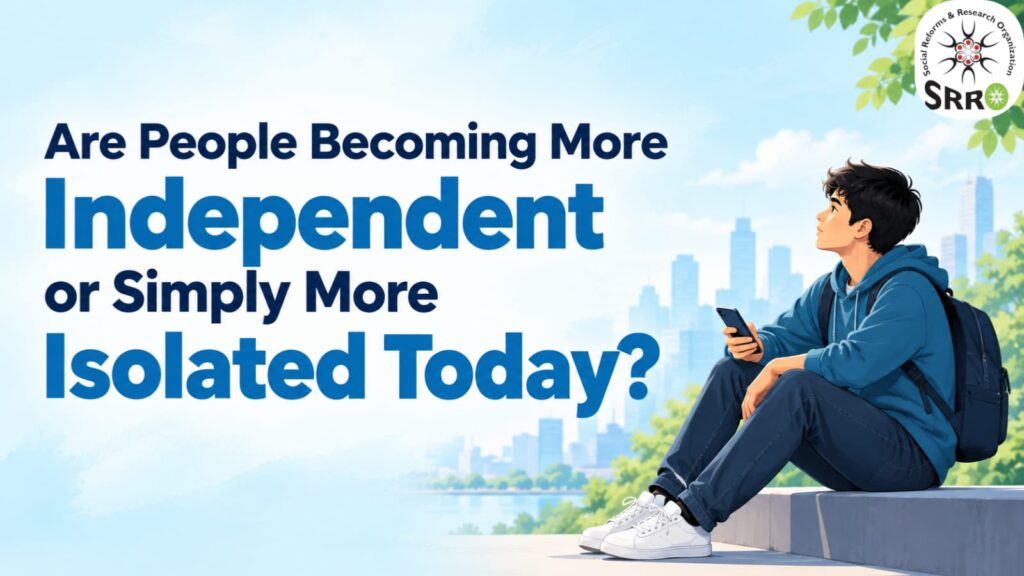
Independence is often viewed as an important characteristic of modern life. Young people today have greater access to education, employment opportunities, technology, information and social networks. These changes can encourage individuals to make their own decisions and manage their lives without depending heavily on others. At the same time, greater self-reliance does not necessarily mean stronger social relationships. A person may be financially or emotionally independent while still experiencing loneliness or disconnection. This survey explores whether people are becoming genuinely more independent, or whether some forms of independence are accompanied by increasing isolation.
Objectives of the Survey
The main objective was to understand how people define independence and how they handle personal difficulties. The survey also examined whom respondents turn to during difficult times, how they perceive young people today, and whether social media is strengthening social connections or contributing to isolation. The responses were used to examine the relationship between independence, emotional dependence, social connection and online interaction.
Methodology
The survey was conducted through Google Forms and received 65 responses. The questionnaire contained five main multiple-choice questions along with demographic questions. Age information was available for 64 respondents, ranging from 15 to 46 years, with a median age of 20 years. The largest age groups were 20 years (17 respondents, 26.6%) and 21 years (14 respondents, 21.9%). Gender information was available for 60 respondents: 34 were female (56.7%) and 26 were male (43.3%). Since not every demographic question was answered by every participant, the number of valid responses varies slightly. Percentages below are based on valid responses.
Findings
The first question asked what being independent means to respondents. A clear majority, (67.2%), selected “all of the above.” This option included making one’s own decisions, earning and managing one’s own money, not depending emotionally on others, and having freedom to live life one’s own way. Among the individual choices, making one’s own decisions was selected by respondents (12.5%), freedom to live life one’s own way by (10.9%), earning and managing money by (7.8%), and not depending emotionally on others by 1 (1.6%). Thus, respondents generally view independence as a combination of practical, financial, emotional and personal freedom.
The second question explored why young people often prefer solving problems on their own. The largest group, 30 of 65 respondents (46.2%), selected “all of the above.” This combined valuing independence, not wanting to burden others, difficulty trusting people, and becoming emotionally distant. Thirteen respondents (20.0%) specifically identified difficulty trusting people, 11 (16.9%) said young people do not want to burden others, and 10 (15.4%) believed they value independence. These results suggest that self-reliance can have different causes: it may reflect confidence and responsibility, but it may also result from reluctance to seek help or difficulty trusting others.
The third question provides one of the strongest indications of possible isolation. When asked whom they would turn to after a bad day, 30 of 65 respondents (46.2%) said “No one – I prefer dealing with it myself.” In comparison, 15 (23.1%) would turn to family, 12 (18.5%) to a close friend, and 8 (12.3%) to a partner or romantic interest. Nearly half therefore prefer handling emotional difficulties alone. This does not automatically mean they are lonely, since some people genuinely prefer privacy and self-reflection, but it shows that emotional self-reliance is common in this sample.
The fourth question asked which situation best describes young people today. The largest group, 28 respondents (43.1%), chose “It depends on the individual.” Seventeen (26.2%) felt that young people are less dependent on family but more dependent on online connections. Ten (15.4%) described them as more independent but still socially connected, while another 10 (15.4%) described them as more independent and more isolated. The results therefore do not support one universal description of today’s youth. Independence can exist alongside either healthy social connection or increased reliance on digital relationships.
Social Media and Isolation
The fifth question produced an important finding. Twenty-six respondents (40.0%) selected “Neither – it depends on how it’s used,” indicating that social media itself may not determine whether people become more connected or isolated. However, 19 respondents (29.2%) believed social media makes young people both more connected and more isolated, while 17 (26.2%) felt that it makes them more isolated despite being constantly connected. Only 3 respondents (4.6%) selected “more socially connected.” Thus, respondents recognise the connecting function of social media but relatively few viewed its overall effect as simply increasing social connection.
Discussion
Taken together, the survey presents a nuanced picture. Respondents strongly associate independence with control over decisions, finances, emotions and lifestyle. At the same time, almost half prefer dealing with difficult days alone. This highlights an important distinction between independence and isolation. Independence can be positive when it means confidence, responsibility and decision-making ability. Isolation, however, involves reduced emotional or social connection. The same behaviour—such as solving a problem alone—can therefore have different meanings depending on the person’s circumstances.
Technology has also complicated the idea of being “connected.” A person can have many online contacts while having few people with whom they feel comfortable sharing personal difficulties. The fact that 29.2% selected both increased connection and increased isolation highlights this contradiction. Meanwhile, the largest response to the social-media question was that its impact depends on how it is used. This cautions against treating social media as automatically harmful or beneficial.
Conclusion
The survey does not show that people are simply becoming either more independent or more isolated. Instead, it points towards a more complex situation in which independence and isolation can exist together. Most respondents view independence broadly and positively, but a substantial proportion also prefer dealing with emotional difficulties alone. Many respondents believe young people are less dependent on family while becoming more reliant on online connections, and social media is widely perceived as capable of producing both connection and isolation.
Overall, the findings suggest that the important issue is not independence itself but the quality of relationships maintained alongside it. Being able to make one’s own decisions and manage one’s life does not require avoiding support from others. Healthy independence can coexist with strong family, friendship and community relationships. The challenge for young people today is to remain self-reliant without allowing self-reliance to become emotional disconnection.
Limitations
The survey was based on only 65 respondents and therefore cannot represent all young people or the entire population. The sample also had more female than male respondents, and most respondents were young adults. Some demographic questions were unanswered. The findings should therefore be understood as a snapshot of this particular group rather than a universal conclusion.
Data Note
The analysis was prepared from the uploaded CSV export of the Google Forms responses. The report does not reproduce respondents’ names. Because some demographic fields were left blank, the valid response count differs across questions.

Written By – Yashika Saini
Research & Survey Intern at SRRO
“SRRO works as an implementation partner for CSR and social impact projects”