Introduction-
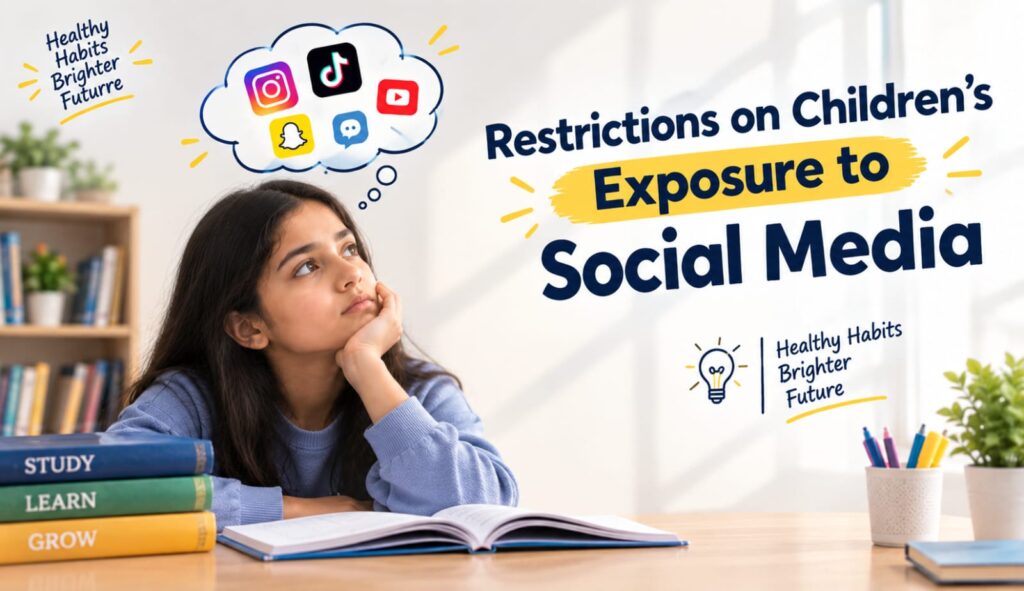
In today’s era of the internet, social media platforms have emerged as a major arena where people choose to spend their time and energy. While social media has its positive aspects such as allowing more interaction, opening our minds to newer ideas, enabling us to share moments from our daily life with other people, it also has some shortcomings. These include mental stress, possibilities of comparisons with others, exposure to similar kinds of content due to algorithm functioning etc. These shortcomings become especially dangerous in case of children. Children have impressionable minds that are easy to mold in one way or the other, and which may drift astray if not guided properly. This has been confirmed by several scientific studies. Driven by fears of children being exposed to inappropriate content, being drawn away from their physical environment, having abnormally high screen times among other things, there have been calls for restrictions to be placed on children’s access to social media. These restrictions have taken the shape of legal bans and restrictions in other jurisdictions, for instance the European Union. As our own government mulls whether and to what extent such restrictions are required, this survey aims to analyze public opinion and sentiment from across age groups. It is a brief survey that asks the responder to engage with what kind, if any, restrictions would they want to be in place with respect to children’s exposure to social media.
Literature Review-
The proliferation of social media has transformed the way children communicate, learn, and engage with the world in a very substantial manner. Existing literature in this particular subject area acknowledges that while social media platforms offer educational opportunities, social interaction and other creative outlets, excessive exposure can harm children’s cognitive and emotional development. Scientific research done over time has rung alarm bells, by showing that prolonged social media use among children and young adults is linked with increased risks of anxiety, depression, cyberbullying, sleep disturbances, reduced attention span, body image issues, and exposure to over-mature content. In response to these concerns, many countries have introduced age-based restrictions and regulatory measures to limit children’s access to social media platforms. However, scholarly debates remain divided on the most appropriate approach. While some scholars advocate for strict regulation and mandatory age verification mechanisms, others argue that parental supervision, raising of awareness and platform accountability are better-suited means of protecting children. The existing literature therefore highlights the need to balance children’s right to participate in the digital arena with the obligation of governments to safeguard their best interests.
Research Gap-
Although considerable research has delved into the effects of social media on the psychology, mental development of children and evaluated legal responses adopted in different countries, lesser attention has been paid to public perceptions regarding the appropriate nature and extent of restrictions on children’s social media access, particularly in the Indian context. Existing studies primarily focus on empirically looking at the harm caused by such exposure or comparing the merit of how different legal systems have tackled this issue. However, fewer studies examine how members of the public perceive this problem, to what extent the government should interfere in it and their awareness of the legal developments going on in other countries. This survey seeks to address this gap by collecting, analysing public opinion on whether children’s exposure to social media should be legally regulated, identifying the age at which such restrictions are considered appropriate, and understanding the concerns that motivate support for regulation, whether legal or non-legal.
Research Objectives-
The objectives of this survey are:
- To assess public awareness of recent international initiatives restricting children’s access to social media.
- To examine public perceptions regarding the impact of unregulated social media exposure on children’s mental health and overall well-being.
- To identify the regulatory approach preferred by respondents, including legal restrictions, parental supervision, or a combination of both.
- To determine the age below which respondents believe children’s access to social media should be monitored or restricted.
- To identify the principal risks associated with children’s unrestricted use of social media, including exposure to harmful content, cyberbullying, misinformation, addiction, and adverse effects on mental health.
This survey has gathered 46 responses to make its assessment
Analysis-
The survey responses indicate a broad societal recognition of the challenges posed by children’s unrestricted access to social media. The respondent pool represented a diverse range of age groups, with the highest participation from individuals aged 19–21 years, thereby incorporating perspectives from different generations.
The findings reveal that awareness of international developments in this area is relatively high, with a significant majority of respondents being aware of measures adopted by countries such as France and Australia to regulate children’s access to social media. This suggests that public discourse surrounding online child safety is increasingly informed by global policy developments.
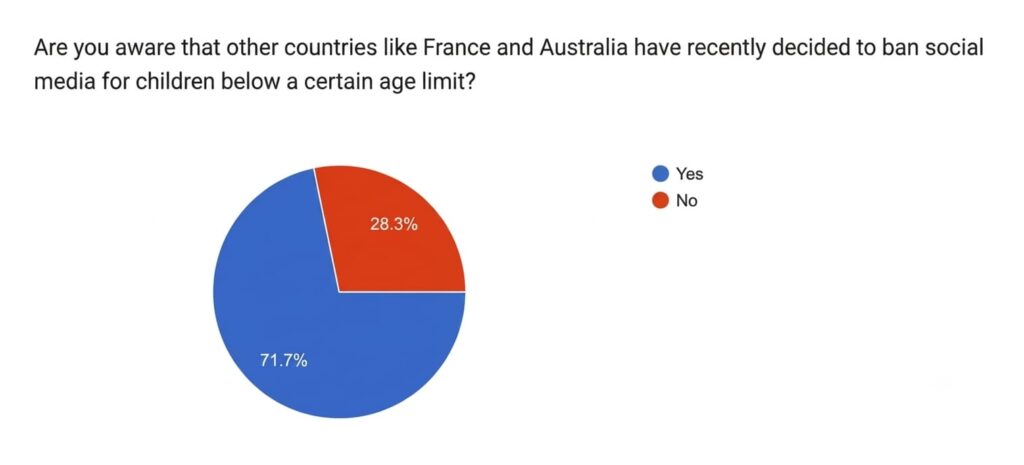
A large percentage of the responders were aware of these legal measures that have been implemented abroad. This shows both high general awareness as well as the fact that people are actively keeping themselves informed of new developments on this front. This knowledge of the legal measures being implemented elsewhere also nudges people to think about the same in their own society.
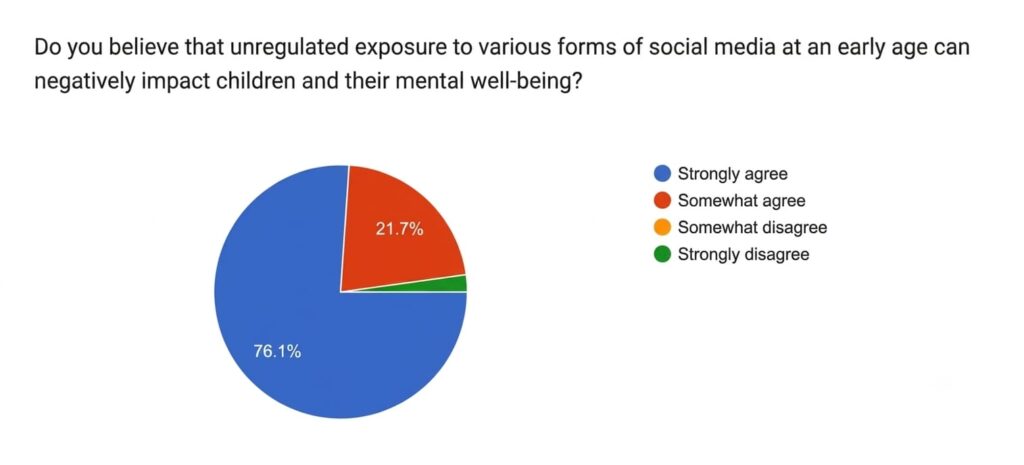
More than two-thirds of the responders strongly agreed that negative impacts follow unregulated exposure of children to social media. A small percentage agrees less strongly, while a miniscule minority believes that this is not the case. Going by the majority response, however, one understands that most people are aware of the various kinds of adverse impacts that social media creates on the minds of children. This may directly correlate to how people feel about taking some action, whether legal or extra-legal, regarding this issue.
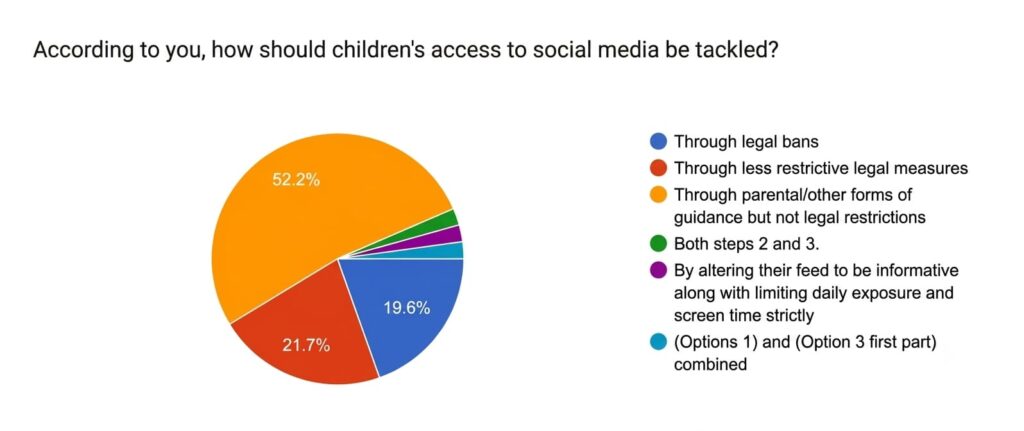
This question received a variety of responses. Slightly more than half of the responders believed that regulation through parental/other forms of guidance but not legal restrictions. Following that, around more than a fifth of the responders (21.7%) believed that less restrictive legal measures than bans are the correct path to follow. Another fifth of the people opted for the most restrictive approach, that is legal bans. The remainder of the responders believed that a combination of some of these legal and extra-legal methods would be the suitable way to proceed.
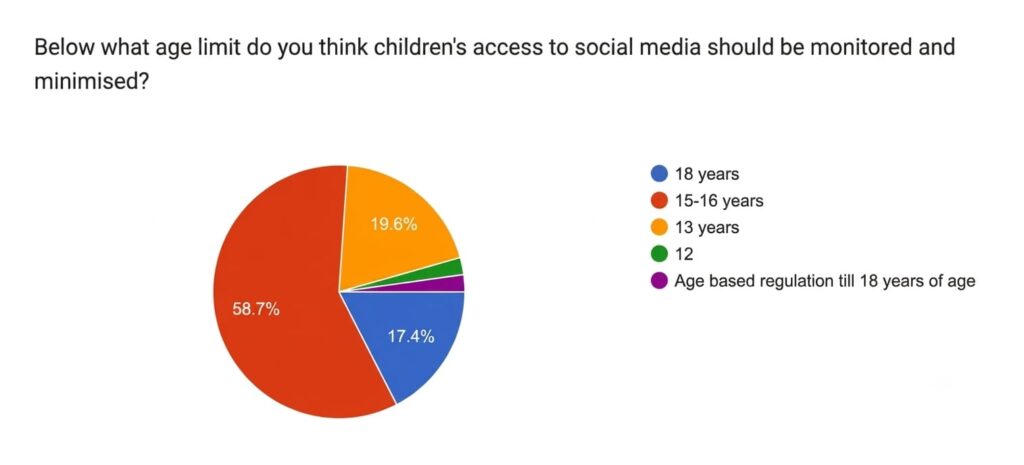
Around 60% of the responders believed that monitoring and regulation is required for children aged below 15-16 years. Following that, around a fifth of the responders believed that children below the age of 13 years, that is pre-adolescents, are the constituency that requires monitoring. Next, around 17.5% of the responders opted for all children below 18 to be regulated. Other minorities of the responders believed that age-based, graded regulation is the correct path.
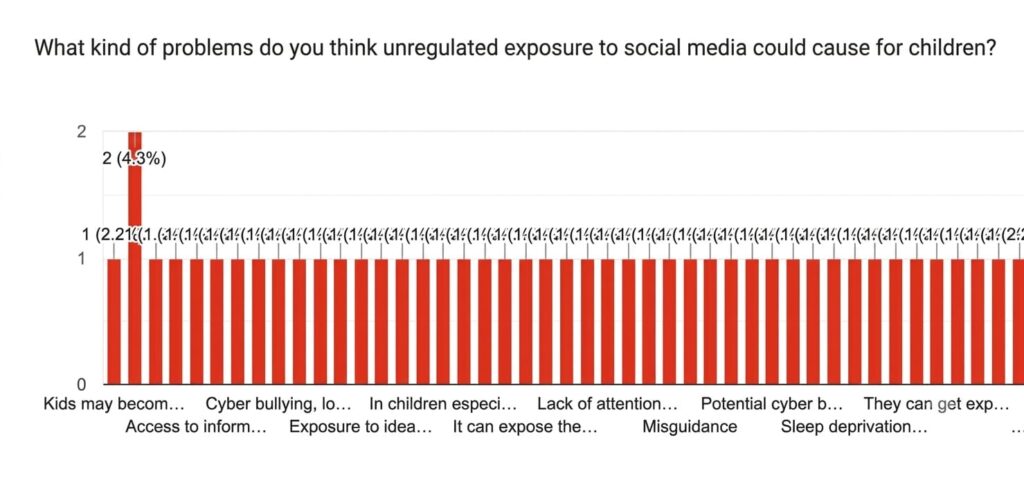
This was a subjective question posed to the responders. The answers varied but commonly spoke of issues such as exposure to age-inappropriate content, cyber bullying, detachment from physical surroundings, increased screen time, effects on mental and physical health, reduced attention span, lack of empathy, stunted development, low self-esteem, exposure to incorrect information, body image concerns, undue distraction, peer pressure etc.
Conclusion-
The survey demonstrates a clear public consensus that children’s unrestricted exposure to social media presents significant risks to their mental health, emotional well-being, and overall development. Respondents acknowledged that while social media offers several benefits, these advantages must be balanced against the potential harms associated with excessive and unsupervised use. The findings also reveal a preference for proportionate regulation rather than absolute prohibition. Most respondents favoured a combination of parental guidance, digital awareness, and carefully designed regulatory measures instead of blanket legal bans. Furthermore, the survey suggests that the public broadly supports age-based safeguards, with a majority identifying children below the age of 15–16 years as requiring greater protection. Collectively, these findings highlight the growing societal expectation that governments, parents, educational institutions, and digital platforms should work together to create a safer online environment for children. The survey underscores the need for a balanced policy framework that protects children’s best interests while enabling them to benefit from the opportunities offered by the digital world.

Written By – Ananya Kohli
Research Intern
“SRRO works as an implementation partner for CSR and social impact projects”