INTRODUCTION
Foreign policy is often discussed less than many other government policies. Policies such as the national budget are frequently debated because people can easily connect them to their daily lives. Foreign policy, however, is often seen as a subject that mainly concerns relations between countries and is therefore left to governments, diplomats, and policy experts.
Yet, foreign policy is also a government policy. In a democracy, governments work on behalf of the people, and public opinion plays an important role in public affairs. Although foreign policy deals with international relations, its effects are not limited to governments alone. Understanding how people view foreign policy can therefore provide useful information into the relationship between government decisions and public opinion.
LITERATURE REVIEW
The article India’s Foreign Policy: Shift, Adjustment and Continuity by Amit Ranjan (2022) discusses the evolution of India’s foreign policy and argues that while policies have adapted to changing global conditions, their core objectives have largely remained unchanged. Similarly, India’s Foreign Policy: Retrospect and Prospect by Sumit Ganguly examines the historical development of India’s foreign policy and highlights the major factors that have shaped India’s external relations since independence. The Belfer Center article on India’s Foreign Policy further discusses the strategic, economic, and security considerations that influence India’s engagement with the international community. Apart from this, India’s Foreign Policy Capacity by C. Raja Mohan focuses on the institutional and diplomatic capabilities required for effective foreign-policy implementation. Finally, Understanding the Indian Public Opinion–Foreign Policy Relationship by Pranay Iyer explores the growing role of public opinion in foreign-policy discussions and decision-making.
RESEARCH GAP
Existing studies have examined India’s foreign policy from historical, strategic, and institutional perspectives. They explain how India’s foreign policy has evolved, the factors influencing its decisions, and the capacities required for its implementation. Some research has also explored the relationship between public opinion and foreign policy, highlighting the growing importance of citizens’ views in democratic policymaking.
However, relatively limited attention has been given to collecting primary, on-ground data from ordinary citizens regarding their awareness of India’s current foreign policy, the sources through which they obtain information, and their perceptions of its impact on everyday life.
Understanding public awareness and opinion is important because foreign policy is not solely a matter of government-to-government relations, its decisions ultimately affect citizens, making their perspectives relevant to democratic policymaking. This article addresses that gap by examining public awareness and attitudes toward India’s current foreign policy through survey-based primary data.
ANALYSIS
To fill this gap, an online survey was conducted. The survey results show that public awareness of India’s current foreign policy exists, but it is uneven. While 31.8% of respondents described themselves as extremely aware, others reported only partial or limited knowledge. This suggests that foreign policy is not an unfamiliar subject, but it is also not deeply understood by everyone. The issue appears to be present in public discussion, yet detailed awareness remains limited among a section of respondents.
A major point that emerges is the difference between awareness and perceived importance. Even though not all respondents claimed strong awareness, many still believed that foreign policy affects the daily lives of common people. This shows that people may not always know the details of policies, diplomatic decisions, or international agreements, but they still recognise that foreign policy can influence ordinary life. This is important because it shows that foreign policy is not seen only as a matter for diplomats or political leaders.
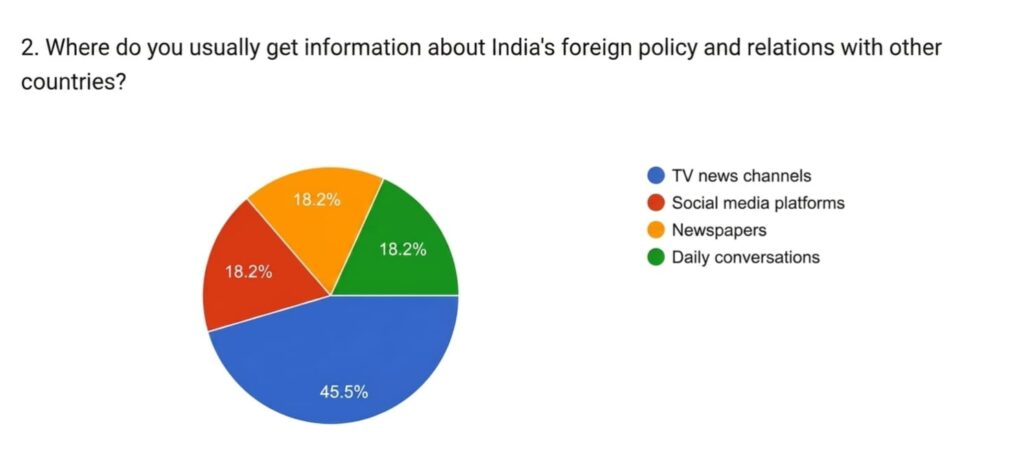
The source of information also plays an important role in shaping public understanding. TV news channels were the most common source of information, selected by 45.5% of respondents. This suggests that traditional media still has a strong influence on how people understand foreign-policy issues. At the same time, responses to memes and informal channels show caution. A significant number of respondents did not consider such sources accurate or trustworthy. This indicates that while informal platforms may spread foreign-policy discussions quickly, respondents do not fully depend on them for reliable information.
The responses also provide insight into the areas where respondents perceive the effects of foreign policy most clearly. When asked which aspect of life is most affected by foreign policy, 40.9% selected jobs and foreign education, making it the most frequently chosen option. This suggests that respondents recognize a connection between international relations and opportunities beyond national borders. The finding indicates that foreign policy is not viewed solely as a matter of diplomacy, but also as something that can influence access to education, employment, and opportunities abroad.
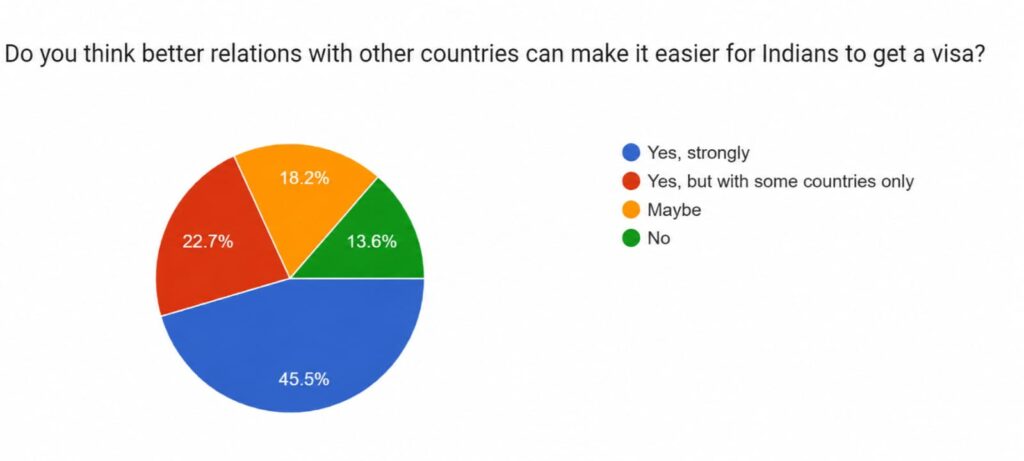
Visa access also appeared as an important concern. In one question, 45.5% of respondents strongly believed that better relations with other countries can make visas easier for Indians. In another question, 31.8% selected easier visa access as the main focus of foreign policy for improving citizens’ lives. These responses show that international mobility is an important part of how respondents think about foreign policy’s impact. For many people, foreign policy becomes meaningful when it affects travel, education, work, or movement across borders.
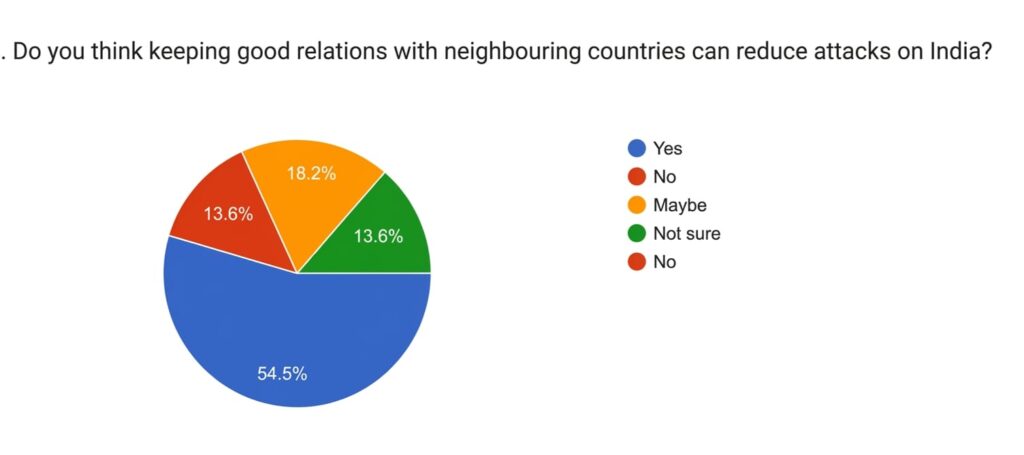
Security is another major theme in the survey. About 54.5% of respondents believed that good relations with neighbouring countries can reduce attacks on India. This shows that many respondents see diplomacy as connected to national safety. Their responses suggest a belief that better relations with neighbouring countries may help reduce tensions and improve security. At the same time, 27.3% selected better safety and security as the focus of foreign policy. This indicates that security remains an important expectation from foreign policy, along with mobility and economic concerns.
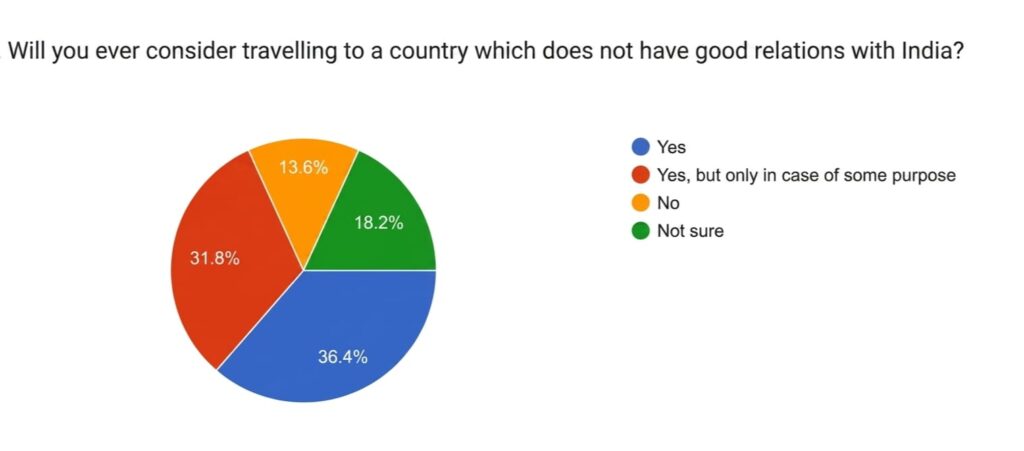
The survey also reveals a practical attitude toward international relations. When asked whether they would travel to a country that does not have good relations with India, 36.4% said yes and 31.8% said yes, but only for some purpose. Only 13.6% said no. This suggests that many respondents do not completely reject personal engagement with countries that may have tense relations with India. Their response shows that personal needs such as travel, education, work, or other purposes may still matter even when political relations between countries are not very strong.
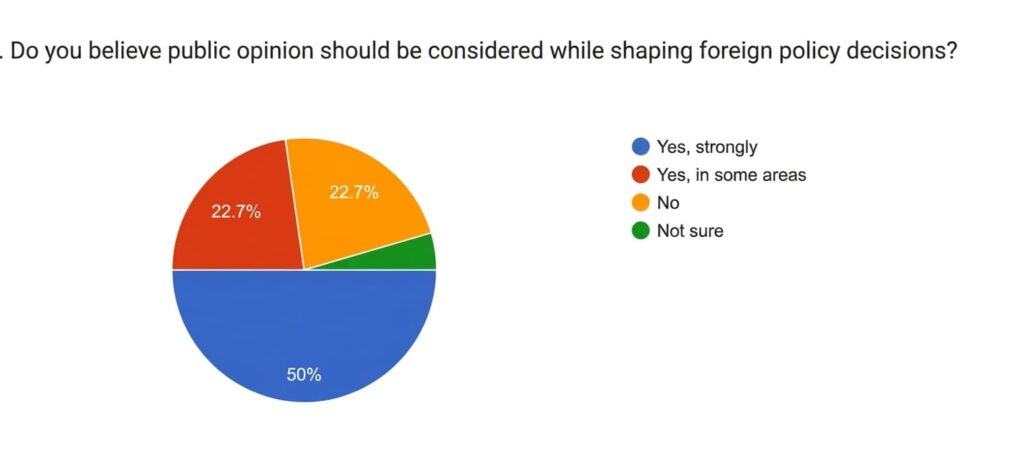
Another important finding is the demand for public involvement. Half of the respondents strongly believed that public opinion should be considered while shaping foreign policy, and half also believed that the government should create more awareness about foreign-policy issues. This connects directly with the research gap of the study. The findings show that respondents do not want foreign policy to remain distant from public discussion. Even when awareness is uneven, there is still a desire for better information and some level of public consideration.
CONCLUSION
Overall, the survey suggests that foreign policy is viewed as both important and relevant, even if detailed awareness is not equally strong among all respondents. The findings show three broad patterns. First, people are aware of foreign policy to different degrees. Second, they depend largely on media sources, especially TV news, for information, and third, they associate foreign policy with practical outcomes such as visas, education, employment, travel, and security. The study therefore addresses its research gap by using primary survey data to understand how ordinary citizens perceive India’s foreign policy and how they connect it with everyday concerns.
REFERENCES
- Survey form:
- https://docs.google.com/forms/d/e/1FAIpQLSd3M8HbW7c3gJWxEBwX8aZbPLGi6qhDTupYQsGSXmdAgpf1ug/viewform?usp=dialog
- Articles (literature section):
- https://www.tandfonline.com/doi/full/10.1080/00358533.2022.2082737
- https://www.ufmg.br/dri/wp-content/uploads/2021/09/indianforeignpolicy_ganguly.pdf
- https://www.belfercenter.org/publication/indias-foreign-policy
- https://www.tandfonline.com/doi/full/10.1080/25741292.2019.1615164
- https://www.orfonline.org/research/understanding-the-indian-public-opinion-foreign-policy-relationship