1. Executive Summary
Unified Payments Interface (UPI), digital wallets, and Buy Now, Pay Later (BNPL) services have made everyday payments fast and convenient. They can also change how spending feels: a quick tap or QR scan may make the loss of money less noticeable than handing over cash, while deferred payment can separate a purchase from its eventual cost. At the same time, transaction histories, alerts, and budgeting features can help users monitor their finances.
In the supplied survey, 10 respondents completed the English module and three completed the Hindi module. Within the English cohort, 80% said a 30-day cash-only scenario would reduce their spending to some degree, and 60% said they could recall their seven-day digital spending within ₹200. The findings suggest both potential risks and signs of active self-management. Because the sample is small and some questions have fewer responses than the total dataset, these results cannot be generalized to all youth.
2. Methodology and Sample
The report uses a descriptive analysis of the supplied survey responses (13 responses in total: 10 in English and three in Hindi), alongside established concepts from research on payment methods and spending. The English cohort was predominantly aged 18–21 (9 of 10). Nine of the 10 English respondents identified as undergraduate or postgraduate students, and six reported a monthly budget or allowance below ₹5,000.
Important data limitation: the supplied summary reports only two Hindi responses for several questions, despite three Hindi survey submissions overall. Therefore, question-level denominators vary. Percentages below are reported for the English cohort where the source provides a clear denominator; they should not be read as population estimates.
3. UPI, Digital Wallets, and the Cashless Effect
The idea of the “pain of paying” describes the psychological discomfort associated with parting with money. Physical cash makes the exchange visible; digital payments can reduce this immediate sensation because the transaction is completed quickly and without handling notes. This does not mean digital payments always cause overspending, but lower friction may make small discretionary purchases easier to repeat.
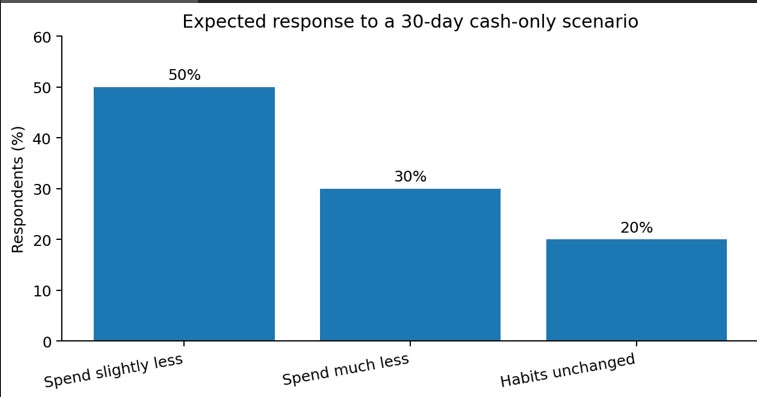
Among the 10 English respondents, four (40%) said they relied mostly or almost entirely on digital payments, while five (50%) used a roughly equal mix of cash and digital payments. In a hypothetical 30-day cash-only scenario, five respondents (50%) expected to spend slightly less, three (30%) expected spending to drop significantly, and two (20%) expected no change. Thus, eight of 10 English respondents anticipated some reduction in spending if digital payments were unavailable.
4. BNPL and the Illusion of Available Money
BNPL services allow customers to receive goods or services before completing payment, often through scheduled repayments. The convenience can be useful when managed carefully, but deferred payment may make it easier to underestimate commitments that will fall due later. A purchase should therefore be assessed against the total repayment obligation—not only the amount due at checkout—and users should understand any fees, missed-payment consequences, and repayment dates.
In the English cohort, six respondents (60%) reported using no short-term financing tool, two (20%) reported credit-card use, and two (20%) reported BNPL-app use. These small counts show that both traditional credit and BNPL were present in the sample; they do not establish how common these products are among young people more broadly.
5. Financial Literacy and Spending Awareness
Digital tools can support financial literacy by keeping searchable transaction records, showing balances, and offering spending summaries. However, access to records is not the same as understanding them: users still need to review transactions, distinguish available balances from credit, and plan for upcoming obligations.
Six of the 10 English respondents (60%) said they actively tracked transactions and knew their remaining daily budget. Three (30%) checked their balance mainly when funds seemed low, while one (10%) reported noticing expenditure only after an end-of-month shock or a failed transaction.
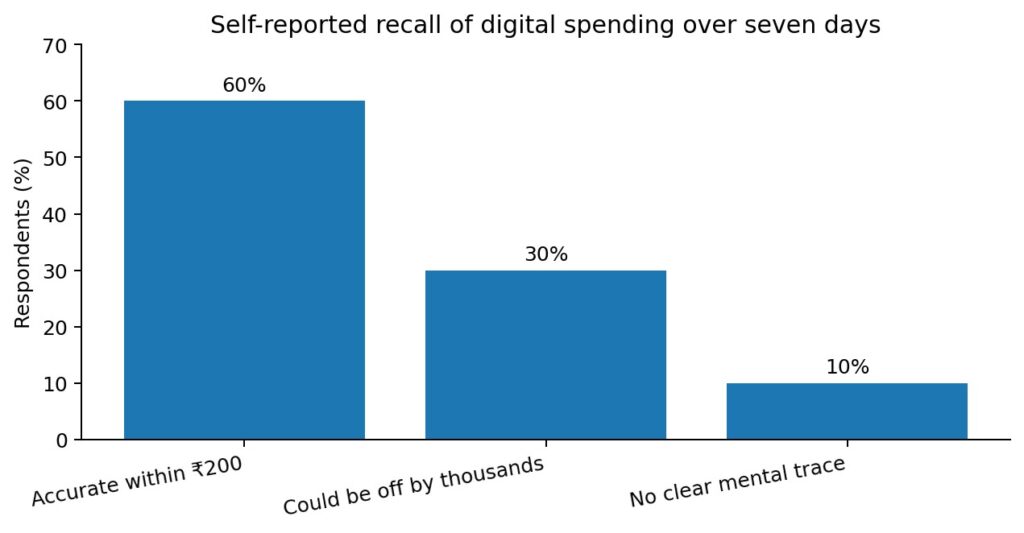
For seven-day spending recall, six respondents (60%) estimated their expenditure within ₹200, three (30%) said their estimate could be off by thousands of rupees, and one (10%) reported having no clear mental trace of the spending.
7. Conclusion
UPI and digital wallets offer speed and useful records, while BNPL offers payment flexibility but adds repayment responsibilities. The survey suggests that some respondents perceive cash as a brake on spontaneous spending, even as many report tracking their budgets successfully. The practical goal is not to reject digital finance, but to pair convenience with transparent credit terms, useful self-control tools, and everyday financial education.
References and Further Reading
- Reserve Bank of India. (2022). Guidelines on Digital Lending. https://www.rbi.org.in/ (Search the RBI website for “Guidelines on Digital Lending, 2022.”)
- Primary source: User-provided survey-response summary, English and Hindi modules (13 total submissions; question-level response counts vary).

Written By- Shabad Singh
Survey & Research Intern at SRRO
“SRRO works as an implementation partner for CSR and social impact projects”